
Stock photo: cover may vary
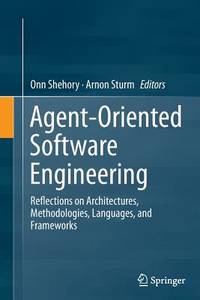
Agent-Oriented Software Engineering: Reflections on Architectures, Methodologies, Languages, and Frameworks Papeback -
by Onn Shehory (Editor); Arnon Sturm (Editor)
- New
A$252.87
A$5.86
Delivery within USA
Standard delivery: 9 to 14 days
More delivery options
Standard delivery: 9 to 14 days
Ships from Cold Books (New York, United States)
Details
- Title Agent-Oriented Software Engineering: Reflections on Architectures, Methodologies, Languages, and Frameworks
- Author Onn Shehory (Editor); Arnon Sturm (Editor)
- Binding Papeback
- Condition New
- Pages 331
- Volumes 1
- Language ENG
- Publisher Springer
- Publication date pp. 345 Softcover reprint of
- Illustrated Yes
- Features Illustrated
- Bookseller's Inventory # 6378370386
- ISBN 9783662522790 / 3662522799
- Weight 1.07 lbs (0.49 kg)
- Dimensions 9.21 x 6.14 x 0.72 in (23.39 x 15.60 x 1.83 cm)
-
Themes
- Aspects (Academic): Science/Technology Aspects
- Category Computers - Languages / Programming
- Dewey Decimal Code 004.6
- Quantity available 4
About Cold Books New York, United States
Reader reviews for Agent-Oriented Software Engineering: Reflections on Architectures, Methodologies, Languages, and Frameworks
Write a review for this book
Important Terms and Guidelines
- Please focus on the book’s content and context. Also, add any personal comments as to how you enjoyed the book. Substantiate your likes and dislikes. You may make comparisons to other books.
- Reviews must be at least 140 characters in length.
- Please do not reveal critical plot elements.
- This is not a help line. Contact customer support if you need help.
Your review must not include:
- Obscenities, discriminatory language, or other insulting language not suitable for public domain
- Advertisements, “spam” content, or references to other products, offers or websites.
- Email addresses, URLs, phone numbers, physical addresses or other contact information.
- Overly critical comments about other reviews or reviewers
- Time-sensitive material (i.e. promotional tours, seminars, lectures, etc.)
- Availability, price, or alternative ordering/shipping information
From the publisher
From the rear cover
With this book, Onn Shehory and Arnon Sturm, together with further contributors, introduce the reader to various facets of agent-oriented software engineering (AOSE). They provide a selected collection of state-of-the-art findings, which combines research from information systems, artificial intelligence, distributed systems, and software engineering and covers essential development aspects of agent-based systems.
The book chapters are organized into five parts. The first part introduces the AOSE domain in general, including introduction to agents and the peculiarities of software engineering for developing MAS. The second part describes general aspects of AOSE, like architectural models, design patterns, and communication. Next, part three discusses AOSE methodologies and associated research directions, and elaborates on Prometheus, O-MaSE, and INGENIAS. Part four then addresses agent-oriented programming languages. Finally, the fifth part presents studies related to the implementation of agents and multi-agent systems.
The book not only provides a comprehensive review of design approaches for specifying agent-based systems, but also covers implementation aspects such as communication, standards, and tools and environments for developing agent-based systems. It is thus of interest to researchers, practitioners, and students who are interested in exploring the agent paradigm for developing software systems.

