
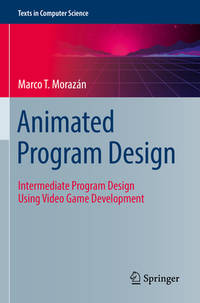
Stock photo: cover may vary
ANIMATED PROGRAM DESIGN Paperback - 2022
by MORAZÁN
- New
- Paperback
A$221.16
A$21.69
Delivery to USA
Standard delivery: 20 to 30 days
More delivery options
Standard delivery: 20 to 30 days
Ships from Sanctum Books (Delhi, India)
Details
- Title ANIMATED PROGRAM DESIGN
- Author MORAZÁN
- Binding Paperback
- Condition New
- Publisher SPRINGER
- Publication date 2022
- Features Illustrated
- Bookseller's Inventory # Adhya-9783031043192
- ISBN 9783031043192
- Quantity available 500
About Sanctum Books Delhi, India
Specialising in: Art, Archaeology, Art History, And Architecture, Dictionaries And Encyclopaedias, Indian History, Languages, Literature, And Linguistics, Music, Dance, Theatre, And Cinema, Numismatics, Philately, And Epigraphy, Philosophy & Philosophy Of Science, Religion (Buddhism, Jainism, Hinduism, Sikhism, And Islam)
Biblio member since 2010
We are leading publishers, booksellers, distributors, importers, and exporters. We carry a large selection of books on varied subjects. Do place your valued order or let us know your requirement via email.
30 day return guarantee, with full refund including shipping costs for up to 30 days after delivery if an item arrives misdescribed or damaged.
�
Books are shipped by Registered Air Mail or DHL/FedEx/Aramex. Additional shipping charges may be required for multi-volume sets.
Reader reviews for ANIMATED PROGRAM DESIGN
Write a review for this book
Important Terms and Guidelines
- Please focus on the book’s content and context. Also, add any personal comments as to how you enjoyed the book. Substantiate your likes and dislikes. You may make comparisons to other books.
- Reviews must be at least 140 characters in length.
- Please do not reveal critical plot elements.
- This is not a help line. Contact customer support if you need help.
Your review must not include:
- Obscenities, discriminatory language, or other insulting language not suitable for public domain
- Advertisements, “spam” content, or references to other products, offers or websites.
- Email addresses, URLs, phone numbers, physical addresses or other contact information.
- Overly critical comments about other reviews or reviewers
- Time-sensitive material (i.e. promotional tours, seminars, lectures, etc.)
- Availability, price, or alternative ordering/shipping information
From the publisher
From the rear cover
This textbook presents a systematic methodology for program development by using design recipes, i.e. a series of steps, each with a specific outcome, that takes a problem solver from a problem statement to a working and tested programmed solution. It introduces the reader to generative recursion, heuristic searching, accumulative recursion, tail recursion, iteration, mutation, loops, program correctness, and vectors. It uses video game development to make the content fun while at the same time teaching problem-solving techniques.
This textbook targets undergraduates at all levels as well as graduate students wishing to learn about program design. It details advanced types of recursion, a disciplined approach to the use of mutation, and illustratesthe design process by developing a video game exploiting iterative refinement.
The book is divided into four parts. Part I presents introductory material on basic problem solving and program design. It starts by reviewing the basic steps of a design recipe using structural recursion on a list. It then proceeds to review code refactoring-a common technique used to refine programs when a better or more elegant way is found to solve a problem-and introduces the reader to randomness. Next, Part II explores a new type of recursioncalled generative recursion. It navigates the reader through examples involving fractal image generation, efficient sorting, and efficient searching techniques such as binary, depth-first, and breadth-first search. Part III then explores a new type of recursion called accumulative (or accumulator) recursion. Examples used include finding a path in a graph, improving insertion sorting, and list-folding operations. Finally, Part IV explores mutation. To aid the reader in properly sequencing mutations it presents Hoare Logic and program correctness. In addition, it introduces vectors, vector processing, in-place operations, and circular data. Throughout the whole book complexity analysis and empirical experimentation is used to evaluate solutions.
This textbook targets undergraduates at all levels as well as graduate students wishing to learn about program design. It details advanced types of recursion, a disciplined approach to the use of mutation, and illustratesthe design process by developing a video game exploiting iterative refinement.

