
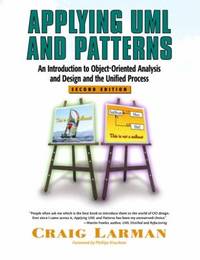
Applying UML and Patterns : An Introduction to Object-Oriented Analysis and Design and the Unified Process Hardback - 2001 - 2nd Edition
by Craig Larman
- Used
- Good
- Hardback
A$9.91
Free Delivery within USA
Standard delivery: 4 to 8 days
More delivery options
Standard delivery: 4 to 8 days
Details
- Title Applying UML and Patterns : An Introduction to Object-Oriented Analysis and Design and the Unified Process
- Author Craig Larman
- Binding Hardback
- Edition number 2nd
- Edition 2
- Condition Used - Good
- Pages 627
- Volumes 1
- Language ENG
- Publisher Prentice Hall PTR, Upper Saddle
- Publication date 2001
- Illustrated Yes
- Bookseller's Inventory # G0130925691I3N00
- ISBN 9780130925695 / 0130925691
- Weight 2.99 lbs (1.36 kg)
- Dimensions 10.33 x 8.35 x 1.15 in (26.24 x 21.21 x 2.92 cm)
- Category Computers - Languages / Programming
- Library of Congress subjects System design, Object-oriented methods (Computer science)
- Library of Congress Catalogue Number 2001036446
- Dewey Decimal Code 005.117
- Quantity available 1
About ThriftBooks Washington, United States
Biblio member since 2018
From the largest selection of used titles, we put quality, affordable books into the hands of readers
Reader reviews for Applying UML and Patterns : An Introduction to Object-Oriented Analysis and Design and the Unified Process
Write a review for this book
Important Terms and Guidelines
- Please focus on the book’s content and context. Also, add any personal comments as to how you enjoyed the book. Substantiate your likes and dislikes. You may make comparisons to other books.
- Reviews must be at least 140 characters in length.
- Please do not reveal critical plot elements.
- This is not a help line. Contact customer support if you need help.
Your review must not include:
- Obscenities, discriminatory language, or other insulting language not suitable for public domain
- Advertisements, “spam” content, or references to other products, offers or websites.
- Email addresses, URLs, phone numbers, physical addresses or other contact information.
- Overly critical comments about other reviews or reviewers
- Time-sensitive material (i.e. promotional tours, seminars, lectures, etc.)
- Availability, price, or alternative ordering/shipping information
From the publisher
First line
What does it mean to have a good object design?

