
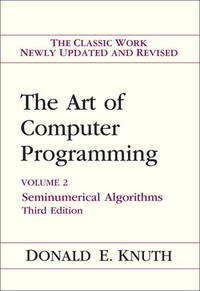
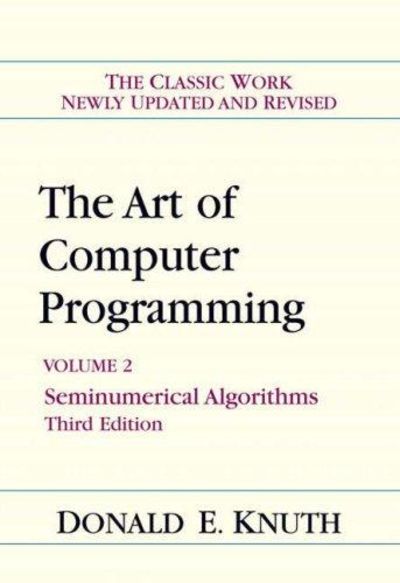
Stock photo: cover may vary
Art of Computer Programming, The: Seminumerical Algorithms, Volume 2 Hardback - 1997
by Knuth, Donald
- Used
- Good
- Hardback
The second book in a three volume set, this book provides a complete introduction to this topic. It presents a readable and coherent summary of the major paradigms and basic theory of semi numerical algorithms, providing a comprehensive interface between computer programming and numerical analysis.
A$38.21
Free Delivery to USA
Standard delivery: 7 to 10 days
More delivery options
Standard delivery: 7 to 10 days
Dropship order
Ships from Ausvora INC (Connecticut, United States)
Details
- Title Art of Computer Programming, The: Seminumerical Algorithms, Volume 2
- Author Knuth, Donald
- Binding Hardback
- Edition 3
- Condition Used - Good
- Pages 784
- Volumes 1
- Language ENG
- Publisher Addison-Wesley Professional, Lebanon, Indiana, U.S.A.
- Publication date 1997-11-04
- Illustrated Yes
- Features Dust Cover, Glossary, Illustrated, Index, Table of Contents
- Bookseller's Inventory # ANAIS-0201896842
- ISBN 9780201896848 / 0201896842
- Weight 2.81 lbs (1.27 kg)
- Dimensions 9.5 x 6.6 x 1.64 in (24.13 x 16.76 x 4.17 cm)
- Size 24.1x16.8x4.2
- Category Computers - Languages / Programming
- Library of Congress subjects Computer programming, Computer algorithms
- Library of Congress Catalogue Number 97002147
- Dewey Decimal Code 005.1
- Quantity available 1
About Ausvora INC Connecticut, United States
Biblio member since 2025
We are a U.S.-based online bookstore specializing in quality used books at affordable prices. With over 1 million books in stock, we serve readers, resellers, libraries, and institutions across the United States and internationally.
Fast & Reliable Shipping All orders ship within 1–2 business days. Domestic shipping across the U.S. via USPS or UPS. International shipping available to most countries. 🔁 30-Day Hassle-Free Returns If the book isn't as described, we'll make it right. Enjoy a full 30-day return window with no questions asked.
Reader reviews for Art of Computer Programming, The: Seminumerical Algorithms, Volume 2
Write a review for this book
Important Terms and Guidelines
- Please focus on the book’s content and context. Also, add any personal comments as to how you enjoyed the book. Substantiate your likes and dislikes. You may make comparisons to other books.
- Reviews must be at least 140 characters in length.
- Please do not reveal critical plot elements.
- This is not a help line. Contact customer support if you need help.
Your review must not include:
- Obscenities, discriminatory language, or other insulting language not suitable for public domain
- Advertisements, “spam” content, or references to other products, offers or websites.
- Email addresses, URLs, phone numbers, physical addresses or other contact information.
- Overly critical comments about other reviews or reviewers
- Time-sensitive material (i.e. promotional tours, seminars, lectures, etc.)
- Availability, price, or alternative ordering/shipping information
From the publisher
From the rear cover
The bible of all fundamental algorithms and the work that taught many of today's software developers most of what they know about computer programming.
--Byte, September 1995
I can't begin to tell you how many pleasurable hours of study and recreation they have afforded me! I have pored over them in cars, restaurants, at work, at home... and even at a Little League game when my son wasn't in the line-up.
--Charles Long
If you think you're a really good programmer... read [Knuth's] Art of Computer Programming... You should definitely send me a resume if you can read the whole thing.
--Bill Gates
It's always a pleasure when a problem is hard enough that you have to get the Knuths off the shelf. I find that merely opening one has a very useful terrorizing effect on computers.
--Jonathan Laventhol
The second volume offers a complete introduction to the field of seminumerical algorithms, with separate chapters on random numbers and arithmetic. The book summarizes the major paradigms and basic theory of such algorithms, thereby providing a comprehensive interface between computer programming and numerical analysis. Particularly noteworthy in this third edition is Knuth's new treatment of random number generators, and his discussion of calculations with formal power series.

