BIBLIO is the largest independent book marketplace in the world, with over 100 million books.

Skip to content

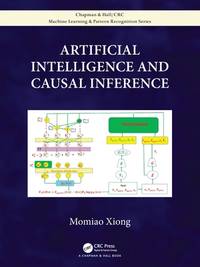
Artificial Intelligence and Causal Inference (Chapman & Hall/CRC Machine Learning & Pattern Recognition)

Artificial Intelligence and Causal Inference (Chapman & Hall/CRC Machine Learning & Pattern Recognition)

Artificial Intelligence and Causal Inference (Chapman & Hall/CRC Machine
Stock photo: cover may vary

Artificial Intelligence and Causal Inference (Chapman & Hall/CRC Machine Learning & Pattern Recognition) Papeback -

by Momiao Xiong

Add to wish list
  • New
  • first
New

Description

First edition Includes bibliographical references and index. Papeback. New.
Ask the seller a question Add to wish list
A$158.15
A$5.81 Delivery within USA
Standard delivery: 9 to 14 days
More delivery options
Ships from Cold Books (New York, United States)

Details

  • Title Artificial Intelligence and Causal Inference (Chapman & Hall/CRC Machine Learning & Pattern Recognition)
  • Author Momiao Xiong
  • Binding Papeback
  • Condition New
  • Pages 368
  • Volumes 1
  • Language ENG
  • Publisher CRC Press
  • Publication date First edition Includes biblio
  • Illustrated Yes
  • Features Bibliography, Illustrated, Index
  • Bookseller's Inventory # 6397719785
  • ISBN 9781032193281 / 103219328X
  • Weight 1.96 lbs (0.89 kg)
  • Dimensions 11 x 8.25 x 0.81 in (27.94 x 20.96 x 2.06 cm)
  • Category Business / Economics / Finance
  • Library of Congress subjects Artificial intelligence, Causation
  • Library of Congress Catalogue Number 2021040988
  • Dewey Decimal Code 006.31
  • Quantity available 4

About Cold Books New York, United States

Biblio member since 2012

Terms of Sale: 30 day return guarantee, with full refund including shipping costs for up to 30 days after delivery if an item arrives misdescribed or damaged.

Browse books from Cold Books

Reader reviews for Artificial Intelligence and Causal Inference (Chapman & Hall/CRC Machine Learning & Pattern Recognition)

From the publisher

Artificial Intelligence and Causal Inference address the recent development of relationships between artificial intelligence (AI) and causal inference. Despite significant progress in AI, a great challenge in AI development we are still facing is to understand mechanism underlying intelligence, including reasoning, planning and imagination. Understanding, transfer and generalization are major principles that give rise intelligence. One of a key component for understanding is causal inference. Causal inference includes intervention, domain shift learning, temporal structure and counterfactual thinking as major concepts to understand causation and reasoning. Unfortunately, these essential components of the causality are often overlooked by machine learning, which leads to some failure of the deep learning. AI and causal inference involve (1) using AI techniques as major tools for causal analysis and (2) applying the causal concepts and causal analysis methods to solving AI problems. The purpose of this book is to fill the gap between the AI and modern causal analysis for further facilitating the AI revolution. This book is ideal for graduate students and researchers in AI, data science, causal inference, statistics, genomics, bioinformatics and precision medicine.

Key Features:

  • Cover three types of neural networks, formulate deep learning as an optimal control problem and use Pontryagin's Maximum Principle for network training.
  • Deep learning for nonlinear mediation and instrumental variable causal analysis.
  • Construction of causal networks is formulated as a continuous optimization problem.
  • Transformer and attention are used to encode-decode graphics. RL is used to infer large causal networks.
  • Use VAE, GAN, neural differential equations, recurrent neural network (RNN) and RL to estimate counterfactual outcomes.
  • AI-based methods for estimation of individualized treatment effect in the presence of network interference.

About the author

Momiao Xiong, is a professor in the Department of Biostatistics and Data Science, University of Texas School of Public Health, and a regular member in the Genetics & Epigenetics (G&E) Graduate Program at The University of Texas MD Anderson Cancer Center, UTHealth Graduate School of Biomedical Science. His interests are artificial intelligence, causal inference, bioinformatics and genomics.

tracking-