BIBLIO is the largest independent book marketplace in the world, with over 100 million books.

Skip to content

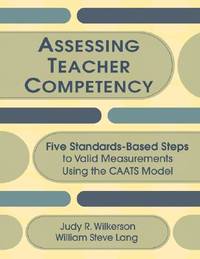
Assessing Teacher Competency: Five Standards-Based Steps to Valid Measurement Using the CAATS Model

Assessing Teacher Competency: Five Standards-Based Steps to Valid Measurement Using the CAATS Model

Assessing Teacher Competency: Five Standards-Based Steps to Valid Measurement
Stock photo: cover may vary

Assessing Teacher Competency: Five Standards-Based Steps to Valid Measurement Using the CAATS Model Paperback - 2007 - 1st Edition

by Wilkerson, Judy R.; Lang, William S

Add to wish list
  • New
  • Paperback
New

Description

Corwin, 2007-04-13. paperback. New. 8x0x11. BRAND NEW, Perfect Shape, No Remainder Mark,
Ask the seller a question Add to wish list
A$47.64
A$5.77 Delivery within USA
Standard delivery: 5 to 14 days
More delivery options
Ships from Poverty Hill Books (Illinois, United States)

Details

About Poverty Hill Books Illinois, United States

Biblio member since 2015

Thank you for stopping by! We have been selling books online for over 19 years. All orders are shipped with delivery confirmation service at no additional charge. Standard shipments are via USPS media mail. Expedited service ships via USPS Priority mail. International orders are shipped via USPS Priority or First Class air mail, all orders are handled with care and shipped promptly in secure packaging. We are open daily. We ship Mon-Sat and send shipment confirmation emails. Our customer service is friendly... have a question, we're always happy to help. Thank you once again for stopping by our shop!

Terms of Sale:

30 day return guarantee, with full refund including original shipping costs for up to 30 days after delivery if an item arrives misdescribed or damaged.

Browse books from Poverty Hill Books

Reader reviews for Assessing Teacher Competency: Five Standards-Based Steps to Valid Measurement Using the CAATS Model

From the publisher

"I have not seen anything quite as systematic as this material in guiding the reader through a process for developing a valid and reliable assessment plan. Covers all the areas one would want in designing a system for accreditation or for other purposes."
--Martha Gage, Director, Teacher Education & Licensure
Kansas State Department of Education

"Realistically reveals the extent of the task of teacher certification and provides us with a structured learning experience that should improve our abilities with this task."
--Pearl Solomon, Associate Professor
St. Thomas Aquinas College

A complete, step-by-step guide to teacher assessments that meet national accreditation and accountability standards.

Written in a reader-friendly style for busy faculty members and school administrators with little or no prior knowledge of statistics, this comprehensive model is designed to create fair, valid, and reliable assessments of teacher knowledge and skills.

Evaluation experts Judy Wilkerson and Steve Lang provide detailed guidance for the complete five-step assessment process, making this an ideal resource both for preservice and inservice settings, including accreditation reviews and teacher induction programs. Offering worksheets and activities to illustrate every step of the process, this all-inclusive handbook covers:

  • Definitions, contextual factors, and sampling
  • Aligning performance tasks with standards defined by NCLB, NCATE, INTASC, and other groups
  • Designing and implementing data tracking and management systems
  • Ensuring psychometric integrity

Valid and reliable decisions about teacher competency are based on fair, valid, and reliable assessment systems. Assessing Teacher Competency is the book all teacher educators, supervisors, and mentors have been waiting for.

About the author

Judy R. Wilkerson is an Associate Professor of Research and Assessment at Florida Gulf Coast University, where she teaches graduate and undergraduate courses in measurement and evaluation. As in this book and all of her research, she focuses her efforts with students on providing a highly pragmatic approach, based in theory, with the goal of instilling a commitment in them to assess K-12 learning. Her Ph.D. is in Measurement and Research from the University of South Florida, where she served for 15 years as Director of Program Review, leading College and University efforts in accreditation. Her career has been dedicated to standards-based assessment of programs and teachers, beginning with the creation of an evaluation model for accreditation in 1987, which she implemented in several states. Beginning in 1990 for 15 years, she served as the primary consultant for higher education to the Florida Department of Education, where she drafted the standards for the initial approval of teacher education programs, designed the program approval process, and provided technical assistance to colleges of education in evaluation of teachers and programs statewide. She has consulted nationally on NCATE accreditation and worked with state associations of teacher educators on accreditation related issues. She has also consulted with school districts in Florida on assessment systems for teachers. She was lead designer of the assessment system for the Florida Alternative Certification Program, now used in over 40 of the 68 school districts in the State.

William Steve Lang is a Professor of Educational Measurement and Research at the University of South Florida St. Petersburg, where he teaches graduate courses in measurement, statistics, and research. He, too, focuses his teaching on making meaningful and pragmatic uses of the disciplines he teaches. He earned his Ph.D. from the University of Georgia in 1984. He has taught as a public school teacher in South Carolina and Georgia and as a college faculty member in South Carolina, Georgia, and Florida. He has published on a variety of applications in educational testing and works extensively with the Rasch Model of Item Response Theory. He began working extensively with Judy when she joined the faculty of the St. Petersburg Campus in 2001. Since that time, they have collaborated in all aspects of their research and service efforts with the Florida Department of Education, Florida school districts, and teacher education programs nationwide. They are working together to build two teacher assessment scales - one on teacher competencies, the subject of this book, and another on dispositions. Their work in both areas is standards-driven.

tracking-