BIBLIO is the largest independent book marketplace in the world, with over 100 million books.

Skip to content

Atomic Pair Distribution Function Analysis: A Primer

Atomic Pair Distribution Function Analysis: A Primer

Atomic Pair Distribution Function Analysis: A Primer Hardback - 2024

by Prof Simon Billinge

Add to wish list
  • New
  • Hardback
New

Description

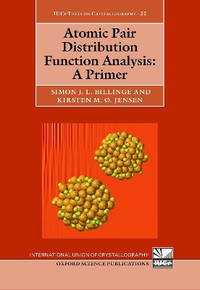
Hardback. New. The book is intended for graduate students and other research scientists who are new to atomic pair distribution function (PDF) and want to use the methods but are unsure how to take the next steps to get started.
Ask the seller a question Add to wish list
A$149.39
A$19.36 Delivery to USA
Standard delivery: 14 to 21 days
More delivery options
Ships from The Saint Bookstore (Merseyside, United Kingdom)

Details

  • Title Atomic Pair Distribution Function Analysis: A Primer
  • Author Prof Simon Billinge
  • Binding Hardback
  • Condition New
  • Pages 272
  • Volumes 1
  • Language ENG
  • Publisher Oxford University Press
  • Publication date 2024-02-23
  • Bookseller's Inventory # A9780198885801
  • ISBN 9780198885801 / 0198885806
  • Weight 1.5 lbs (0.68 kg)
  • Dimensions 9.3 x 7.1 x 1.2 in (23.62 x 18.03 x 3.05 cm)
  • Category Science
  • Quantity available 10

About The Saint Bookstore Merseyside, United Kingdom

Biblio member since 2018

The Saint Bookstore specialises in hard to find titles & also offers delivery worldwide for reasonable rates.

Terms of Sale: Refunds or Returns: A full refund of the price paid will be given if returned within 30 days in undamaged condition. If the product is faulty, we may send a replacement.

Browse books from The Saint Bookstore

Reader reviews for Atomic Pair Distribution Function Analysis: A Primer

From the publisher

Since the early 1990s the atomic pair distribution function (PDF) analysis of powder diffraction data has undergone something of a revolution in its ability to do just that: yield important structural information beyond the average crystal structure of a material. With the advent of advanced sources, computing and algorithms, it is now useful for studying the structure of nanocrystals, clusters and molecules in solution or otherwise disordered in space, nanoporous materials and things intercalated into them, and to look for local distortions and defects in crystals. It can be used in a time-resolved way to study structural changes taking place during synthesis and in operating devices, and to map heterogeneous systems.

Although the experiments are somewhat straightforward, there can be a gap in knowledge when trying to use PDF to extract structural information by modelling. This book addresses this gap and guides the reader through a series of real life worked examples that gradually increase in complexity so the reader can have the independence and confidence to apply PDF methods to their own research and answer their own scientific questions.

The book is intended for graduate students and other research scientists who are new to PDF and want to use the methods but are unsure how to take the next steps to get started.

About the author

Simon Billinge, Professor of Materials Science and of Applied Physics and of Applied Mathematics, Department of Applied Physics and Applied Mathematics, Columbia University, , Kirsten Jensen, Associate Professor of Chemistry

Professor Billinge has dedicated his life to finding and characterizing local structures, local distortions and hidden symmetries in materials. It all started with an undergrad in Metallurgy and Materials Science at Oxford University, then a PhD at University of Pennsylvania. This led to an interest in the physics of materials and the physics of scattering and a 13 year stint in a Physics and Astronomy Department at Michigan State University. Since 2008 he has been in his current position at Columbia University, with an additional 14 year joint appointment at Brookhaven National Laboratory. He is best known for his contributions to the development of the PDF method, the topic of this book, into a powerful modern materials characterization tool.

Kirsten M. . Jensen's undergraduate and PhD studies were both completed at Aarhus University in Denmark, graduating in 2013. She was at this point already very interested in structure/property relations in nanoscale materials, and after her PhD, she joined Prof. Billinge's group at Columbia University for a postdoctoral fellowship. She has been at University of Copenhagen since 2015 where she leads her research group. She is known for her innovative application of x-ray scattering methods, and especially PDF analysis, to problems in nanomaterials chemistry.

tracking-