
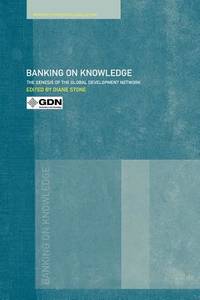
Stock photo: cover may vary
Banking on Knowledge: The Genesis of the Global Development Network (Routledge Studies in Globalisation) Paperback - 2000
by Stone, Diane
- Used
- very good
- Paperback
A$29.03
A$25.01
Delivery to USA
Standard delivery: 5 to 8 days
More delivery options
Standard delivery: 5 to 8 days
Details
- Title Banking on Knowledge: The Genesis of the Global Development Network (Routledge Studies in Globalisation)
- Author Stone, Diane
- Binding Paperback
- Edition First Edition
- Condition Used - Very good
- Pages 288
- Volumes 1
- Language ENG
- Publisher Routledge, London, United Kingdom
- Publication date Nov 23, 2000
- Features Bibliography, Index, Table of Contents
- Bookseller's Inventory # XTR-LOT-VG9
- ISBN 9780415248488 / 0415248485
- Weight 0.97 lbs (0.44 kg)
- Dimensions 9.2 x 6.18 x 0.69 in (23.37 x 15.70 x 1.75 cm)
- Category Business / Economics / Finance
- Library of Congress subjects Communication in economic development, Economic development - Research
- Library of Congress Catalogue Number 00055329
- Dewey Decimal Code 338.900
- Quantity available 1
About Pigeonhouse Books, Dublin Dublin, Ireland
Specialising in: Fiction, Gaa, Irish History, Irish Language, Irish Law, Irish Local Studies, Non-Fiction, Rare Books, University Books
Biblio member since 2022
Pigeonhouse Books is a private Dublin archive of the unusual and the hard-to-find. Founded by an experienced journalist and history graduate, the company specialises in finding and making available specialist items that may never make the rare-book headlines but are essential to the researcher, scientist, academic, collector, student, layperson and - most importantly - the reader, whatever their interests and wherever they may be in the world. Pigeonhouse is a colloquial name pointing to the red and white towers of the former Poolbeg Generating Station at the estuary of the River Liffey - an icon of Dublin for those who arrive or leave, and a newfound symbol of arty modernism in Ireland. The private Pigeonhouse warehouse is located nearby and is home to nearly 10,000 books and countless moving-image, audio and material-culture resources. Here, obscure government reports and local histories are shelved next to a significant international motorsport archive; signed JG Ballard and Flann O'Brien classics share the room with countless legal texts and statute books, a surprising collection of vintage musical and electronic equipment and high-res reproduction materials, and footage on VHS, 8-mm, DVD and hard-drive digital formats. Visitors are always welcome by appointment at Parliament Street in Dublin 2, the city of Joyce and a UNESCO City of Literature. Please drop us a line in advance: all are very welcome to inspect and collect any item in our catalogue in person. Any queries? Do keep in touch at pigeonhousebooksdublin@gmail.com.
Reader reviews for Banking on Knowledge: The Genesis of the Global Development Network (Routledge Studies in Globalisation)
Write a review for this book
Important Terms and Guidelines
- Please focus on the book’s content and context. Also, add any personal comments as to how you enjoyed the book. Substantiate your likes and dislikes. You may make comparisons to other books.
- Reviews must be at least 140 characters in length.
- Please do not reveal critical plot elements.
- This is not a help line. Contact customer support if you need help.
Your review must not include:
- Obscenities, discriminatory language, or other insulting language not suitable for public domain
- Advertisements, “spam” content, or references to other products, offers or websites.
- Email addresses, URLs, phone numbers, physical addresses or other contact information.
- Overly critical comments about other reviews or reviewers
- Time-sensitive material (i.e. promotional tours, seminars, lectures, etc.)
- Availability, price, or alternative ordering/shipping information

