
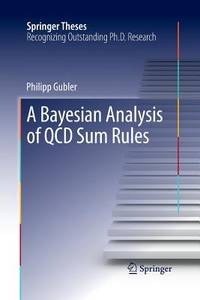
Stock photo: cover may vary
A Bayesian Analysis of QCD Sum Rules (Springer Theses) Papeback -
by Philipp Gubler
- New
A$232.38
A$5.78
Delivery within USA
Standard delivery: 9 to 14 days
More delivery options
Standard delivery: 9 to 14 days
Ships from Cold Books (New York, United States)
Details
- Title A Bayesian Analysis of QCD Sum Rules (Springer Theses)
- Author Philipp Gubler
- Binding Papeback
- Condition New
- Pages 190
- Volumes 1
- Language ENG
- Publisher Springer
- Publication date pp. 206
- Illustrated Yes
- Features Illustrated
- Bookseller's Inventory # 6378342197
- ISBN 9784431546962 / 4431546960
- Weight 0.66 lbs (0.30 kg)
- Dimensions 9.21 x 6.14 x 0.44 in (23.39 x 15.60 x 1.12 cm)
- Category Science
- Dewey Decimal Code 530.14
- Quantity available 4
About Cold Books New York, United States
Reader reviews for A Bayesian Analysis of QCD Sum Rules (Springer Theses)
Write a review for this book
Important Terms and Guidelines
- Please focus on the book’s content and context. Also, add any personal comments as to how you enjoyed the book. Substantiate your likes and dislikes. You may make comparisons to other books.
- Reviews must be at least 140 characters in length.
- Please do not reveal critical plot elements.
- This is not a help line. Contact customer support if you need help.
Your review must not include:
- Obscenities, discriminatory language, or other insulting language not suitable for public domain
- Advertisements, “spam” content, or references to other products, offers or websites.
- Email addresses, URLs, phone numbers, physical addresses or other contact information.
- Overly critical comments about other reviews or reviewers
- Time-sensitive material (i.e. promotional tours, seminars, lectures, etc.)
- Availability, price, or alternative ordering/shipping information
From the rear cover
The author develops a novel analysis method for QCD sum rules (QCDSR) by applying the maximum entropy method (MEM) to arrive at an analysis with less artificial assumptions than previously held. This is a first-time accomplishment in the field.
In this thesis, a reformed MEM for QCDSR is formalized and is applied to the sum rules of several channels: the light-quark meson in the vector channel, the light-quark baryon channel with spin and isospin 1/2, and several quarkonium channels at both zero and finite temperatures.
This novel technique of combining QCDSR with MEM is applied to the study of quarkonium in hot matter, which is an important probe of the quark-gluon plasma currently being created in heavy-ion collision experiments at RHIC and LHC.

