
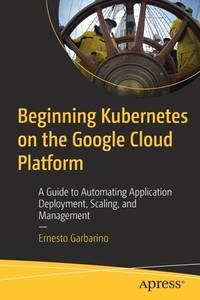
Stock photo: cover may vary
Beginning Kubernetes on the Google Cloud Platform: A Guide to Automating Application Deployment, Scaling, and Management Paperback - 2019
by Garbarino, Ernesto
- New
A$54.88
A$5.86
Delivery within USA
Standard delivery: 5 to 11 days
More delivery options
Standard delivery: 5 to 11 days
Ships from Ambis Enterprises LLC (Michigan, United States)
Details
- Title Beginning Kubernetes on the Google Cloud Platform: A Guide to Automating Application Deployment, Scaling, and Management
- Author Garbarino, Ernesto
- Binding Paperback
- Condition New
- Pages 324
- Volumes 1
- Language ENG
- Publisher Apress
- Publication date 2019-11-29
- Illustrated Yes
- Features Illustrated
- Bookseller's Inventory # OTF-S-9781484254905
- ISBN 9781484254905 / 1484254902
- Weight 1.04 lbs (0.47 kg)
- Dimensions 9.21 x 6.14 x 0.7 in (23.39 x 15.60 x 1.78 cm)
- Category Computers - General Information
- Dewey Decimal Code 004.6
- Quantity available 76
About Ambis Enterprises LLC Michigan, United States
Specialising in: New Books, Used Books
Biblio member since 2009
We love books, and love our customers. We underrate our book conditions to ensure you're happy, and handpack our shipments with pride!
30 day return guarantee, with full refund including shipping costs for up to 30 days after delivery if an item arrives damaged. Please Contand us at Admin@lakesidebooks.com
Reader reviews for Beginning Kubernetes on the Google Cloud Platform: A Guide to Automating Application Deployment, Scaling, and Management
Write a review for this book
Important Terms and Guidelines
- Please focus on the book’s content and context. Also, add any personal comments as to how you enjoyed the book. Substantiate your likes and dislikes. You may make comparisons to other books.
- Reviews must be at least 140 characters in length.
- Please do not reveal critical plot elements.
- This is not a help line. Contact customer support if you need help.
Your review must not include:
- Obscenities, discriminatory language, or other insulting language not suitable for public domain
- Advertisements, “spam” content, or references to other products, offers or websites.
- Email addresses, URLs, phone numbers, physical addresses or other contact information.
- Overly critical comments about other reviews or reviewers
- Time-sensitive material (i.e. promotional tours, seminars, lectures, etc.)
- Availability, price, or alternative ordering/shipping information
From the publisher
From the rear cover
Use this beginner's guide to understand and work with Kubernetes on the Google Cloud Platform and go from single monolithic Pods (the smallest unit deployed and managed by Kubernetes) all the way up to distributed, fault-tolerant stateful backing stores.
You need only a familiarity with Linux, Bash, and Python to successfully use this book. Proficiency in Docker or cloud technology is not required. You will follow a learn-by-doing approach, running small experiments and observing the effects. Google open sourced Kubernetes in 2015 and now it is the standard in container orchestration and adopted by Microsoft (Azure PKS) and Amazon (AWS EKS) in the public cloud, and RedHat (OpenShift) and Pivotal (PKS) in the private cloud. Even though Kubernetes is offered by all of the market-leading cloud providers, the Google Cloud Platform (GCP) offers an integrated shell (Google Cloud Shell) and a $300 credit to get started, which makes it the ideal platform to not only learn Kubernetes but also to implement final production workloads.
You will:
You need only a familiarity with Linux, Bash, and Python to successfully use this book. Proficiency in Docker or cloud technology is not required. You will follow a learn-by-doing approach, running small experiments and observing the effects. Google open sourced Kubernetes in 2015 and now it is the standard in container orchestration and adopted by Microsoft (Azure PKS) and Amazon (AWS EKS) in the public cloud, and RedHat (OpenShift) and Pivotal (PKS) in the private cloud. Even though Kubernetes is offered by all of the market-leading cloud providers, the Google Cloud Platform (GCP) offers an integrated shell (Google Cloud Shell) and a $300 credit to get started, which makes it the ideal platform to not only learn Kubernetes but also to implement final production workloads.
You will:
- Set up a Kubernetes cluster in GCP
- Deploy simple Docker images using monolithic Pods
- Arrange highly available and highly scalable applications using Deployments
- Achieve zero-downtime deployments using the Service controller
- Externalize configuration using ConfigMaps and Secrets
- Set up batch processes and recurrent tasks using Jobs and CronJobs
- Install horizontal (sidecar pattern) services using DaemonSets
- Implement distributed, stateful backing stores using StatefulSets

