
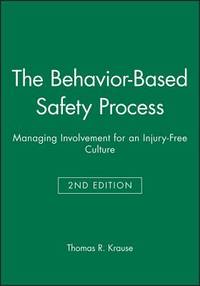
Stock photo: cover may vary
The Behavior-Based Safety Process: Managing Involvement for an Injury-Free Culture, 2nd Edition Hardback - 1996 - 2nd Edition
by Krause, Thomas R
- New
- Hardback
A$109.54
A$21.74
Delivery within USA
Standard delivery: 12 to 14 days
More delivery options
Standard delivery: 12 to 14 days
Dropship order
Ships from Ergodebooks (Texas, United States)
Details
- Title The Behavior-Based Safety Process: Managing Involvement for an Injury-Free Culture, 2nd Edition
- Author Krause, Thomas R
- Binding Hardback
- Edition number 2nd
- Edition 2
- Condition New
- Pages 368
- Volumes 1
- Language ENG
- Publisher Wiley
- Publication date 1996-10-08
- Features Bibliography
- Bookseller's Inventory # DADAX047128758X
- ISBN 9780471287582 / 047128758X
- Weight 1.53 lbs (0.69 kg)
- Dimensions 8.8 x 6.62 x 1.13 in (22.35 x 16.81 x 2.87 cm)
- Size 2.00x29.00x15.00
- Category Business / Economics / Finance
- Dewey Decimal Code 658.408
- Quantity available 1
About Ergodebooks Texas, United States
Biblio member since 2005
Our goal is to provide best customer service and good condition books for the lowest possible price. We are always honest about condition of book. We list book only by ISBN # and hence exact book is guaranteed.
We have 30 day return policy.
Reader reviews for The Behavior-Based Safety Process: Managing Involvement for an Injury-Free Culture, 2nd Edition
Write a review for this book
Important Terms and Guidelines
- Please focus on the book’s content and context. Also, add any personal comments as to how you enjoyed the book. Substantiate your likes and dislikes. You may make comparisons to other books.
- Reviews must be at least 140 characters in length.
- Please do not reveal critical plot elements.
- This is not a help line. Contact customer support if you need help.
Your review must not include:
- Obscenities, discriminatory language, or other insulting language not suitable for public domain
- Advertisements, “spam” content, or references to other products, offers or websites.
- Email addresses, URLs, phone numbers, physical addresses or other contact information.
- Overly critical comments about other reviews or reviewers
- Time-sensitive material (i.e. promotional tours, seminars, lectures, etc.)
- Availability, price, or alternative ordering/shipping information
From the publisher
First line
"An opening note about terms, orientation, and scope."
From the rear cover
The Behavior-Based Safety Process Since the behavior-based approach to accident prevention was launched in 1980 by the author and his associates, safety performance is increasingly prominent on the agendas of many companies. Several powerful factors contribute to this trend. The widespread reorganization of personnel into work-groups that are leaner and more self-directed, the increasing importance of international competition, the growing awareness of critical environmental issues?these and related factors highlight the value of any mechanism that promotes continuous improvement in safety performance. Detailing a step-by-step approach to just such a mechanism for continuous improvement, The Behavior-Based Safety Process is a path-breaking guide that represents an important resource for anyone concerned with performance related issues in the workplace. As the title indicates, the focus is on process versus programs. The reason is simple: off-the-shelf safety imposed from the top down does not meet the safety needs of most organizations. This fact has been abundantly demonstrated in facility after facility throughout the 1970s and 1980s. In genuinely meeting the need for continuous improvement in safety performance, the behavior-based approach presents many parallels with the quality improvement process. Both of these approaches use scientific methods to identify, measure, and provide feedback on upstream factors of excellence. In the case of the behavior-based approach to safety, these upstream factors are critical behaviors that are the leading indicators of safety performance in the organization, targeting areas of concern in advance of even first-aid incidents. For an in-depth treatment of how to integrate behavioral and statistical methodologies, see the author's companion volume from Van Nostrand Reinhold: Employee-Driven Systems for Safe Behavior. In addition to presenting these parallels with quality. The Behavior-Based Safety Process also provides powerful techniques aimed at implementation issues: organizational development, trainer-training, and employee involvement. The author and his associates developed these techniques over a decade of consultation with a variety of industries, working closely in that time with such safety leaders as Monsanto, Shell Chemical Company, ARCO Chemical, ALCOA, Rohm and Haas, Scott Paper Company, Georgia Gulf Corporation, The Pillsbury Company, and Chevron U.S.A.

