
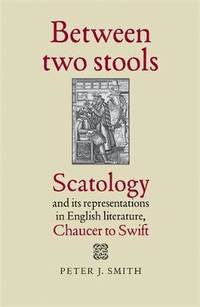
Between two stools : Scatology and its representations in English literature, Chaucer to Swift Hardback - 2012
by Peter J. Smith
- New
- Hardback
A$166.87
A$15.51
Delivery to USA
Standard delivery: 7 to 12 days
More delivery options
Standard delivery: 7 to 12 days
Ships from Ria Christie Collections (Greater London, United Kingdom)
Details
- Title Between two stools : Scatology and its representations in English literature, Chaucer to Swift
- Author Peter J. Smith
- Binding Hardback
- Condition New
- Pages 304
- Volumes 1
- Language ENG
- Publisher Manchester University Press
- Publication date 2012-08-01
- Illustrated Yes
- Features Bibliography, Dust Cover, Illustrated
- Bookseller's Inventory # ria9780719087943_inp
- ISBN 9780719087943 / 0719087945
- Weight 1.1 lbs (0.50 kg)
- Dimensions 8.7 x 5.4 x 1.1 in (22.10 x 13.72 x 2.79 cm)
-
Themes
- Chronological Period: Medieval (500-1453) Studies
- Cultural Region: British
- Interdisciplinary Studies: Medieval (500-1453) Studies
- Category Literature - Classics / Criticism
- Dewey Decimal Code 820.9
- Quantity available 2
About Ria Christie Collections Greater London, United Kingdom
Biblio member since 2014
Hello We are professional online booksellers. We sell mostly new books and textbooks and we do our best to provide a competitive price. We are based in Greater London, UK. We pride ourselves by providing a good customer service throughout, shipping the items quickly and replying to customer queries promptly. Ria Christie Collections
30 day return guarantee, with full refund including original shipping costs for up to 30 days after delivery if an item arrives misdescribed or damaged.
Reader reviews for Between two stools : Scatology and its representations in English literature, Chaucer to Swift
Write a review for this book
Important Terms and Guidelines
- Please focus on the book’s content and context. Also, add any personal comments as to how you enjoyed the book. Substantiate your likes and dislikes. You may make comparisons to other books.
- Reviews must be at least 140 characters in length.
- Please do not reveal critical plot elements.
- This is not a help line. Contact customer support if you need help.
Your review must not include:
- Obscenities, discriminatory language, or other insulting language not suitable for public domain
- Advertisements, “spam” content, or references to other products, offers or websites.
- Email addresses, URLs, phone numbers, physical addresses or other contact information.
- Overly critical comments about other reviews or reviewers
- Time-sensitive material (i.e. promotional tours, seminars, lectures, etc.)
- Availability, price, or alternative ordering/shipping information
From the publisher
From the rear cover
Between two stools investigates the representation of scatology - humorous, carnivalesque, satirical, damning and otherwise - in English literature from the middle ages to the eighteenth century. While a number of recent publications have attempted to analyse the employment of scatology in literature, culture or the arts, they remain, to date, rare examples of a preparedness to discuss such material. This study is the first to consider the topic over such a long historical period, allowing a thorough and original exploration of its foundations and traditions.
Smith contends that the 'two stools' stand for two broadly distinctive attitudes towards scatology. The first is a carnivalesque, merry, even hearty disposition, typified by the writings of Chaucer and Shakespeare. The second is self-disgust, an attitude characterised by withering misanthropy and hypochondria. He locates this shift in sensibility in the crisis of the English Civil War and the aftermath of the Restoration. Smith demonstrates how the combination of high and low cultures manifests the capacity to run canonical and carnivalesque together so that sanctioned and civilised artefacts and scatological humour frequently co-exist in the works under discussion, evidence of an earlier culture's aptitude (now lost) to occupy a position between two stools. Of interest to cultural and literary historians, this ground-breaking study testifies to the arrival of scatology as an academic subject, at the same time recognising that it remains if not outside, then at least at the margins of conventional scholarship.
