
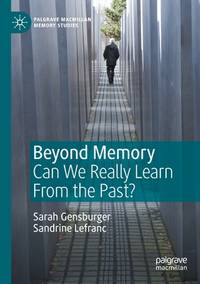
Stock photo: cover may vary
Beyond Memory: Can We Really Learn From the Past? Paperback - 2021
by Sarah Gensburger
- New
A$167.88
A$5.82
Delivery within USA
Standard delivery: 2 to 14 days
More delivery options
Standard delivery: 2 to 14 days
Ships from GreatBookPrices (Maryland, United States)
Details
- Title Beyond Memory: Can We Really Learn From the Past?
- Author Sarah Gensburger
- Binding Paperback
- Condition New
- Pages 128
- Volumes 1
- Language ENG
- Publisher Palgrave Pivot
- Publication date 2021-02-21
- Illustrated Yes
- Features Illustrated
- Bookseller's Inventory # 43082516-n
- ISBN 9783030342043 / 3030342042
- Weight 0.38 lbs (0.17 kg)
- Dimensions 8.27 x 5.83 x 0.3 in (21.01 x 14.81 x 0.76 cm)
- Category Sociology
- Dewey Decimal Code 302.23
- Quantity available 5
About GreatBookPrices Maryland, United States
Biblio member since 2024
Since 1991, we have worked every day to serve our customers with state-of-the-art technology and world class service. We are dedicated to providing customers around the world with the widest selection of books, DVDs, and CDs at the absolute lowest price.
Reader reviews for Beyond Memory: Can We Really Learn From the Past?
Write a review for this book
Important Terms and Guidelines
- Please focus on the book’s content and context. Also, add any personal comments as to how you enjoyed the book. Substantiate your likes and dislikes. You may make comparisons to other books.
- Reviews must be at least 140 characters in length.
- Please do not reveal critical plot elements.
- This is not a help line. Contact customer support if you need help.
Your review must not include:
- Obscenities, discriminatory language, or other insulting language not suitable for public domain
- Advertisements, “spam” content, or references to other products, offers or websites.
- Email addresses, URLs, phone numbers, physical addresses or other contact information.
- Overly critical comments about other reviews or reviewers
- Time-sensitive material (i.e. promotional tours, seminars, lectures, etc.)
- Availability, price, or alternative ordering/shipping information
From the publisher
From the rear cover
This book provides a fresh perspective on the familiar belief that memory policies are successful in building peaceful societies. Whether in a stable democracy or in the wake of a violent political conflict, this book argues that memory policies are unhelpful in preventing hate, genocide, and mass crimes. Since the 1990s, transmitting the memory of violent pasts has been utilised in attempts to foster tolerance and fight racism, hate and antisemitism. However, countries that invested in memory policies have overseen the rise of hate crimes and populisms instead of growing social cohesion. Breaking with the usual moralistic position, this book takes stock of this situation. Where do these memory policies come from? Whom do they serve? Can we make them more effective? In other words, can we really learn from the past? At a time when memory studies is blooming, this book questions the normative belief in the effects of memory.

