BIBLIO is the largest independent book marketplace in the world, with over 100 million books.

Skip to content

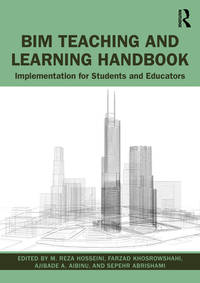
BIM Teaching and Learning Handbook: Implementation for Students and Educators

BIM Teaching and Learning Handbook: Implementation for Students and Educators

BIM Teaching and Learning Handbook: Implementation for Students and Educators
Stock photo: cover may vary

BIM Teaching and Learning Handbook: Implementation for Students and Educators Paperback - 2024

by M. Reza Hosseini

Add to wish list
  • Used
New

Description

like new.
Ask the seller a question Add to wish list
A$163.81
A$5.78 Delivery within USA
Standard delivery: 2 to 14 days
More delivery options
Ships from GreatBookPrices (Maryland, United States)

Details

  • Title BIM Teaching and Learning Handbook: Implementation for Students and Educators
  • Author M. Reza Hosseini
  • Binding Paperback
  • Condition New
  • Pages 354
  • Volumes 1
  • Language ENG
  • Publisher Routledge
  • Publication date 2024-01-29
  • Illustrated Yes
  • Features Illustrated
  • Bookseller's Inventory # 47205294
  • ISBN 9781032034720 / 1032034726
  • Weight 1.35 lbs (0.61 kg)
  • Dimensions 9.69 x 6.85 x 0.77 in (24.61 x 17.40 x 1.96 cm)
  • Category Architecture
  • Dewey Decimal Code 720.285
  • Quantity available 5

About GreatBookPrices Maryland, United States

Biblio member since 2024

Since 1991, we have worked every day to serve our customers with state-of-the-art technology and world class service. We are dedicated to providing customers around the world with the widest selection of books, DVDs, and CDs at the absolute lowest price.

Terms of Sale: 30 day return guarantee, with full refund including original shipping costs for up to 30 days after delivery if an item arrives misdescribed or damaged.

Browse books from GreatBookPrices

Reader reviews for BIM Teaching and Learning Handbook: Implementation for Students and Educators

From the publisher

This book is the essential guide to the pedagogical and industry-inspired considerations that must shape how BIM is taught and learned. It will help academics and professional educators to develop programmes that meet the competences required by professional bodies and prepare both graduates and existing practitioners to advance the industry towards higher efficiency and quality.

To date, systematic efforts to integrate pedagogical considerations into the way BIM is learned and taught remain non-existent. This book lays the foundation for forming a benchmark around which such an effort is made. It offers principles, best practices, and expected outcomes necessary to BIM curriculum and teaching development for construction-related programs across universities and professional training programmes. The aim of the book is to:

  • Highlight BIM skill requirements, threshold concepts, and dimensions for practice;
  • Showcase and introduce tried-and-tested practices and lessons learned in developing BIM-related curricula from leading educators;
  • Recognise and introduce the baseline requirements for BIM education from a pedagogical perspective;
  • Explore the challenges, as well as remedial solutions, pertaining to BIM education at tertiary education;
  • Form a comprehensive point of reference, covering the essential concepts of BIM, for students;
  • Promote and integrate pedagogical consideration into BIM education.

This book is essential reading for anyone involved in BIM education, digital construction, architecture, and engineering, and for professionals looking for guidance on what the industry expects when it comes to BIM competency.

About the author

M. Reza Hosseini is currently the associate head of school (research) at the School of Architecture and Built Environment, Deakin University; a research fellow of the Centre for Research in Assessment and Digital Learning (CRADLE); and the founder and leader of the Australian BIM Academic Forum (ABAF). He had 12 years of experience working in various areas of the construction industry prior to joining the academic world. His main research and teaching areas are building information modelling (BIM) and digital engineering, and he has written around 190 published papers and book chapters.

Farzad Khosrowshahi is dean of the College of Engineering and Science at Victoria University, Melbourne, and Fellow of the Chartered Institute of Building. He is the founder of the BIM Academic Forum, Information Visualisation Society, and Uniting Construction Information. Farzad has previously served as the director of Construct IT, chair of ARCOM (Association of Researchers in Construction Management), and chair of IV Society. He has served on a number of committees including The European Council for Construction Research, Development and Innovation, buildingSMART UK, and the Construction Industry Council Research & Innovation.

Ajibade A. Aibinu is an associate professor at the Faculty of Architecture, Building and Planning, The University of Melbourne, Australia, where he was the Assistant Dean, Research Training. His research interests cut across the built environment project and asset management, from design and construction to operations, particularly data-driven processes to ensure value for money. He is the founder of Intelligent Cost Manager, a cloud-based cost-management solution that leverages deep learning and predictive modelling to generate cost estimates with greater accuracy using historical data. Ajibade is a member of the Australian Institute of Quantity Surveyors and was previously an associate of the Chartered Institute of Arbitrators (2008-2013).

Sepehr Abrishami is a BIM programme leader and senior lecturer in the School of Civil Engineering and Surveying at the University of Portsmouth, UK. He has carried out extensive research in the field of BIM, automation in design and construction, and environmental design. His areas of expertise include building information modelling (BIM), generative and parametric evolutionary design, artificial intelligence (AI), digital design and construction, integrated design, design for manufacturing and assembly (DfMA), offsite manufacturing, Big Data, blockchain, Internet of Things (IoT), and IT integrated architectural design.

tracking-