
Stock photo: cover may vary
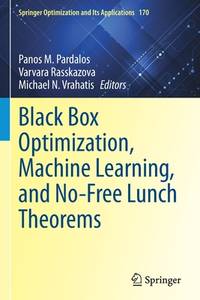
Black Box Optimization, Machine Learning, and No-Free Lunch Theorems (Springer Optimization and Its Applications) Papeback - 2021
by Panos M. Pardalos (Editor); Varvara Rasskazova (Editor); Michael N. Vrahatis (Editor)
- New
A$327.61
A$5.85
Delivery within USA
Standard delivery: 9 to 14 days
More delivery options
Standard delivery: 9 to 14 days
Ships from Cold Books (New York, United States)
Details
- Title Black Box Optimization, Machine Learning, and No-Free Lunch Theorems (Springer Optimization and Its Applications)
- Author Panos M. Pardalos (Editor); Varvara Rasskazova (Editor); Michael N. Vrahatis (Editor)
- Binding Papeback
- Condition New
- Pages 388
- Volumes 1
- Language ENG
- Publisher Springer
- Publication date 1st ed. 2021 edition NO-PA1
- Illustrated Yes
- Features Illustrated
- Bookseller's Inventory # 6395057662
- ISBN 9783030665173 / 3030665178
- Weight 1.23 lbs (0.56 kg)
- Dimensions 9.21 x 6.14 x 0.82 in (23.39 x 15.60 x 2.08 cm)
- Category Mathematics
- Quantity available 4
About Cold Books New York, United States
Reader reviews for Black Box Optimization, Machine Learning, and No-Free Lunch Theorems (Springer Optimization and Its Applications)
Write a review for this book
Important Terms and Guidelines
- Please focus on the book’s content and context. Also, add any personal comments as to how you enjoyed the book. Substantiate your likes and dislikes. You may make comparisons to other books.
- Reviews must be at least 140 characters in length.
- Please do not reveal critical plot elements.
- This is not a help line. Contact customer support if you need help.
Your review must not include:
- Obscenities, discriminatory language, or other insulting language not suitable for public domain
- Advertisements, “spam” content, or references to other products, offers or websites.
- Email addresses, URLs, phone numbers, physical addresses or other contact information.
- Overly critical comments about other reviews or reviewers
- Time-sensitive material (i.e. promotional tours, seminars, lectures, etc.)
- Availability, price, or alternative ordering/shipping information
From the publisher
From the rear cover
This edited volume illustrates the connections between machine learning techniques, black box optimization, and no-free lunch theorems. Each of the thirteen contributions focuses on the commonality and interdisciplinary concepts as well as the fundamentals needed to fully comprehend the impact of individual applications and problems. Current theoretical, algorithmic, and practical methods used are provided to stimulate a new effort towards innovative and efficient solutions. The book is intended for beginners who wish to achieve a broad overview of optimization methods and also for more experienced researchers as well as researchers in mathematics, optimization, operations research, quantitative logistics, data analysis, and statistics, who will benefit from access to a quick reference to key topics and methods. The coverage ranges from mathematically rigorous methods to heuristic and evolutionary approaches in an attempt to equip the reader with different viewpoints of the same problem.

