
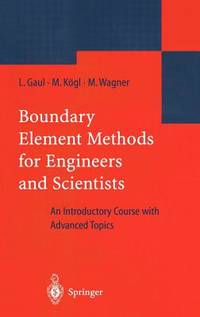
Stock photo: cover may vary
Boundary Element Methods for Engineers and Scientists Hardback - 2003 - 1st Edition
by Lothar Gaul; Martin Kögl; Marcus Wagner
- Used
A$118.85
A$5.78
Delivery within USA
Standard delivery: 2 to 14 days
More delivery options
Standard delivery: 2 to 14 days
Ships from GreatBookPrices (Maryland, United States)
Details
- Title Boundary Element Methods for Engineers and Scientists
- Author Lothar Gaul; Martin Kögl; Marcus Wagner
- Binding Hardback
- Edition number 1st
- Edition 1
- Condition New
- Pages 488
- Language ENG
- Publisher Springer
- Publication date April 30, 2003
- Bookseller's Inventory # 1817738
- ISBN 9783540004639
- Quantity available 5
About GreatBookPrices Maryland, United States
Biblio member since 2024
Since 1991, we have worked every day to serve our customers with state-of-the-art technology and world class service. We are dedicated to providing customers around the world with the widest selection of books, DVDs, and CDs at the absolute lowest price.
Reader reviews for Boundary Element Methods for Engineers and Scientists
Write a review for this book
Important Terms and Guidelines
- Please focus on the book’s content and context. Also, add any personal comments as to how you enjoyed the book. Substantiate your likes and dislikes. You may make comparisons to other books.
- Reviews must be at least 140 characters in length.
- Please do not reveal critical plot elements.
- This is not a help line. Contact customer support if you need help.
Your review must not include:
- Obscenities, discriminatory language, or other insulting language not suitable for public domain
- Advertisements, “spam” content, or references to other products, offers or websites.
- Email addresses, URLs, phone numbers, physical addresses or other contact information.
- Overly critical comments about other reviews or reviewers
- Time-sensitive material (i.e. promotional tours, seminars, lectures, etc.)
- Availability, price, or alternative ordering/shipping information
From the publisher
First line
In the design of engineering structures, numerical simulations play an increasingly important role.
From the rear cover
This introductory course on the classical Boundary Element Method also contains advanced topics such as the Dual Reciprocity and the Hybrid Boundary Element Methods. The latter methods are extensions that permit the application of BME to anisotropic materials, as well as multi-field problems and fluid-structure interaction. The class-tested textbook offers a clear and easy-to-understand introduction to the subject, including worked-out examples that describe all the basic features of the method. The first two chapters not only establish the mathematical basis for BEM but also review the basics of continuum mechanics for field problems, perhaps a unique feature for a text on numerical methods. This helps the reader to understand the physical principles of the field problems, to apply the method judiciously, and toe critically evaluate the results.

