BIBLIO is the largest independent book marketplace in the world, with over 100 million books.

Skip to content

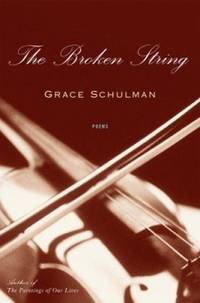
The Broken String

The Broken String

The Broken String Hardback - 2007

by Grace Schulman

Add to wish list
  • Used
  • Good
  • Hardback
Used - Good

Description

Houghton Mifflin Harcourt Publishing Company, 2007. Hardcover. Good. Pages can have notes/highlighting. Spine may show signs of wear. ~ ThriftBooks: Read More, Spend Less.Dust jacket quality is not guaranteed.
Ask the seller a question Add to wish list
A$15.30
Free Delivery within USA
Standard delivery: 4 to 8 days
More delivery options
Ships from ThriftBooks (Washington, United States)

Details

  • Title The Broken String
  • Author Grace Schulman
  • Binding Hardback
  • Edition First Edition
  • Condition Used - Good
  • Pages 84
  • Volumes 1
  • Language ENG
  • Publisher Houghton Mifflin Harcourt Publishing Company, Boston, MA
  • Publication date 2007
  • Bookseller's Inventory # G0618443703I3N00
  • ISBN 9780618443703 / 0618443703
  • Weight 0.5 lbs (0.23 kg)
  • Dimensions 9.07 x 5.3 x 0.51 in (23.04 x 13.46 x 1.30 cm)
  • Category Poetry
  • Library of Congress subjects New York (N.Y.), Long Island (N.Y.)
  • Library of Congress Catalogue Number 2006026928
  • Dewey Decimal Code 811.54
  • Quantity available 1

About ThriftBooks Washington, United States

Biblio member since 2018

From the largest selection of used titles, we put quality, affordable books into the hands of readers

Terms of Sale: 30 day return guarantee, with full refund including original shipping costs for up to 30 days after delivery if an item arrives misdescribed or damaged.

Browse books from ThriftBooks

Summary

One of the finest poets writing today, Grace Schulman finds a sacred radiance in vivid scenes of the city and the sea. The title of this new collection refers to Itzhak Perlman's will to play a violin concerto despite a missing string, which inspires the poet's celebration of life in its fullness and limitations. For her, song imparts endurance: Thelonious Monk evokes Creation when he snaps his fingers "as though to shape the pain into order"; John Coltrane's improvisations embody her own heart's desire to "get it right on the first take"; the wind plays a harp-shaped oak "that has been salt-bleached, cut, whipped to buckle, and has, instead, stood fast"; and her immigrant forebears remember their past by singing prayers on a ship bound for New York.

As in her previous books, Schulman juxtaposes people of different worlds to reveal their unity. "Headstones," which won the American Scholar's Phi Beta Kappa Award for the best poem of 2004, records the isolation of two outsiders, her grandfather Dave and a Montauk sachem, Wyandanch. She percieves the joy shared by Emerson, Beethoven, Turner, and a monk who inked the Bible. At a downtown intersection where churches and a synagogue stand together, the poet recalls that "music soared in quarrels, / moans, blues, calls-and-responses, hymns that rose up / together from stone."

Grace Schulman praises the day even in moments of sorrow, and finds order in art and nature that enables her to stand fast in a threatened world.

Reader reviews for The Broken String

From the publisher

One of the finest poets writing today, Grace Schulman finds a sacred radiance in vivid scenes of the city and the sea. The title of this new collection refers to Itzhak Perlman's will to play a violin concerto despite a missing string, which inspires the poet's celebration of life in its fullness and limitations. For her, song imparts endurance: Thelonious Monk evokes Creation when he snaps his fingers "as though to shape the pain into order"; John Coltrane's improvisations embody her own heart's desire to "get it right on the first take"; the wind plays a harp-shaped oak "that has been salt-bleached, cut, whipped to buckle, and has, instead, stood fast"; and her immigrant forebears remember their past by singing prayers on a ship bound for New York.
As in her previous books, Schulman juxtaposes people of different worlds to reveal their unity. "Headstones," which won the American Scholar's Phi Beta Kappa Award for the best poem of 2004, records the isolation of two outsiders, her grandfather Dave and a Montauk sachem, Wyandanch. She percieves the joy shared by Emerson, Beethoven, Turner, and a monk who inked the Bible. At a downtown intersection where churches and a synagogue stand together, the poet recalls that "music soared in quarrels, / moans, blues, calls-and-responses, hymns that rose up / together from stone."
Grace Schulman praises the day even in moments of sorrow, and finds order in art and nature that enables her to stand fast in a threatened world.

Excerpt

The Broken String 1 When Itzhak Perlman raised his violin and felt the string snap, he sank and looked down at legs unfit to stand and cross the stage for a replacement. He bowed to the maestro, played radiant chords, and finished the concerto

with the strings he had. Rage forced low notes as this surf crashes on rock, turns, and lifts.
Later, he smiled and said it’s what you do: not just play the score, but make new music with what you have, then with what you have left.

2 What you have left: Bill Evans at the keyboard, Porgy. The sound rose, but one note, unworthy, stalled in his head above the weightless chords, above the bass, the trumpet’s holler: Porgy.
A sudden clenched fist rose, pounded the keys,

fell limp: a heroin shot had hit a nerve.
I Loves You, Porgy. Sundays at the Vanguard he soloed, improvised — his test that starved nameless fear. Hands pitted against each other, like the sea’s crosscurrents, played away anger.

3 My father bowed before the Knabe piano, scanned notes, touched fingers lightly, and began, by some black art, I thought, his hearing gone for years. And always, Mozart, Liszt, Beethoven.
One day I gasped, for there were runs

he never heard, played as a broken kite string launches a lifelike eagle that might soar on what the flier holds, what he has left.
Not even winds that howl along these shores and raise the surf can ever ground that flight.

Late Snow

First day of spring and winter can’t let go.
I can’t let go, through dread, of silver maybes: of black that glows, as a cowbird’s sheen, of gray dawns when, mud-colored, slow,

the river to the west gurgles hosannas.
Now near the end of the middle of my life, all I want is more wakings like this one, to watch day break, hear the trash truck growl,

glance at my love’s body, shadowy under bed linen, shaping a luminous question.
I’ll have a pale sun strike the air conditioner, turn its ice particles into asterisks,

and wake a bewitched maple that will bloom despite the park’s tossed soda cans, dope fumes, dog piss, rat poison, banal conversation — green as on the first day of Creation.

Northern Mockingbird

Day comes up like dirt islands at low tide, revealing what I cannot lose: gulls circling, a skiff upended, caulked for a new launching, a tern flying in place before a dive,

lobster traps hidden in phragmites to catch — what, Moses? Long days promise miracles.
But there, on the juniper’s topmost bough, a bird does its high-wire act, twisting

as though for ballast, singing two-note phrases: the years, the years. Rank bird, how it persists.
Showoff. Not singing. Mimicking, cleverly mocking my dream to hold this day forever.

The northern mockingbird, of the same species Walt Whitman heard on this same shore, and penciled in his diary. Not the same bird, of course, but with a heritage, a long line,

if not long life. Its message is harsh.
I won’t see it forever, nor the juniper sprung up inside the center of a rosebush grown, somehow undaunted, on dry sand,

unless my song can recycle this day and pass it on like flotsam, in a sea that inlays glass, wears white stones smooth, and tosses them, shining, on this shore.

Come, love, let us run into the waves past the rosebush on fire, dodging clamshells, though an echoing bird calls, years, the years, and a worn fence unrolls like thumbed pages.

Copyright © 2007 by Grace Schulman. Reprinted by permission of Houghton Mifflin Company

Media reviews

"[Grace Schulman] is an elegiac, highly original religious lyricist . . . The Broken String surpasses her distinguished previous work." --Harold Bloom
tracking-