
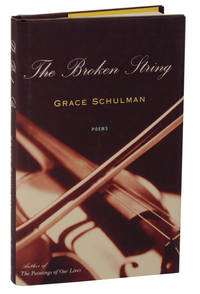
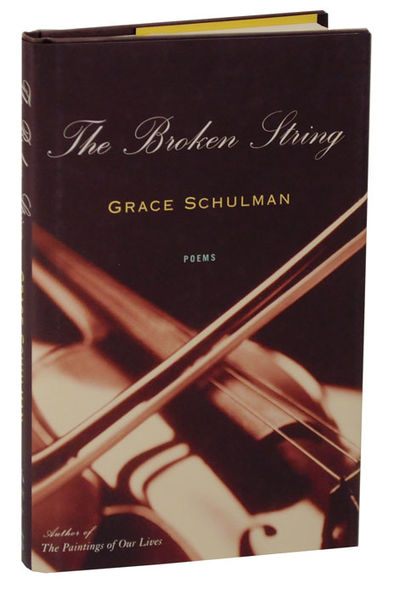
The Broken String Hardback - 2007
by SCHULMAN, Grace
- Used
- first
A$21.89
A$10.22
Delivery within USA
Standard delivery: 3 to 14 days
More delivery options
Standard delivery: 3 to 14 days
Details
- Title The Broken String
- Author SCHULMAN, Grace
- Binding Hardback
- Edition First Edition
- Pages 84
- Volumes 1
- Language ENG
- Publisher Houghton Mifflin Company, Boston, MA
- Publication date 2007
- Bookseller's Inventory # 115786
- ISBN 9780618443703 / 0618443703
- Weight 0.5 lbs (0.23 kg)
- Dimensions 9.07 x 5.3 x 0.51 in (23.04 x 13.46 x 1.30 cm)
- Category Poetry
- Library of Congress subjects New York (N.Y.), Long Island (N.Y.)
- Library of Congress Catalogue Number 2006026928
- Dewey Decimal Code 811.54
- Quantity available 1
About Jeff Hirsch Books, ABAA Illinois, United States
Specialising in: Art, Broadsides, Drama, Literature, Modern First Editions, Photography, Poetry, Signed Books
Biblio member since 2008


We are members of ABAA, ILAB and Midwest Antiquarian Booksellers Association. We specialize in First Editions of 20th century photography, art, design, literature, drama, poetry, and signed books. We are not an open shop but always welcome inquiries.
Books are subject to prior sale. Libraries, institutions, and accredited dealers in the United States can be sent books with invoice. All books noted as First Editions are also First Printings unless indicated otherwise. Books are returnable for any reason within 10 days provided they are returned in the same condition they were sent.
Biblio collects all sales taxes for the appropriate states.
biblio collects taxes for orders going to Australia, Canada, Euro Zone, New Zealand, Norway, and the United Kingdom as required by each country. For other areas, you will be responsible for all customs or tax charges for importation. We do not pay this charges. If you have a tax number for your country, please email it to us as this will expedite your package through customs.
Orders usually ship within 2 business days. Shipping costs are based on books weighing 3 LB, or .41 KG. However, larger or heavier books or multi-volume sets will require additional postage. We will contact you if additional postage is required.
Summary
One of the finest poets writing today, Grace Schulman finds a sacred radiance in vivid scenes of the city and the sea. The title of this new collection refers to Itzhak Perlman's will to play a violin concerto despite a missing string, which inspires the poet's celebration of life in its fullness and limitations. For her, song imparts endurance: Thelonious Monk evokes Creation when he snaps his fingers "as though to shape the pain into order"; John Coltrane's improvisations embody her own heart's desire to "get it right on the first take"; the wind plays a harp-shaped oak "that has been salt-bleached, cut, whipped to buckle, and has, instead, stood fast"; and her immigrant forebears remember their past by singing prayers on a ship bound for New York.
As in her previous books, Schulman juxtaposes people of different worlds to reveal their unity. "Headstones," which won the American Scholar's Phi Beta Kappa Award for the best poem of 2004, records the isolation of two outsiders, her grandfather Dave and a Montauk sachem, Wyandanch. She percieves the joy shared by Emerson, Beethoven, Turner, and a monk who inked the Bible. At a downtown intersection where churches and a synagogue stand together, the poet recalls that "music soared in quarrels, / moans, blues, calls-and-responses, hymns that rose up / together from stone."
Grace Schulman praises the day even in moments of sorrow, and finds order in art and nature that enables her to stand fast in a threatened world.
As in her previous books, Schulman juxtaposes people of different worlds to reveal their unity. "Headstones," which won the American Scholar's Phi Beta Kappa Award for the best poem of 2004, records the isolation of two outsiders, her grandfather Dave and a Montauk sachem, Wyandanch. She percieves the joy shared by Emerson, Beethoven, Turner, and a monk who inked the Bible. At a downtown intersection where churches and a synagogue stand together, the poet recalls that "music soared in quarrels, / moans, blues, calls-and-responses, hymns that rose up / together from stone."
Grace Schulman praises the day even in moments of sorrow, and finds order in art and nature that enables her to stand fast in a threatened world.
Reader reviews for The Broken String
Write a review for this book
Important Terms and Guidelines
- Please focus on the book’s content and context. Also, add any personal comments as to how you enjoyed the book. Substantiate your likes and dislikes. You may make comparisons to other books.
- Reviews must be at least 140 characters in length.
- Please do not reveal critical plot elements.
- This is not a help line. Contact customer support if you need help.
Your review must not include:
- Obscenities, discriminatory language, or other insulting language not suitable for public domain
- Advertisements, “spam” content, or references to other products, offers or websites.
- Email addresses, URLs, phone numbers, physical addresses or other contact information.
- Overly critical comments about other reviews or reviewers
- Time-sensitive material (i.e. promotional tours, seminars, lectures, etc.)
- Availability, price, or alternative ordering/shipping information

