
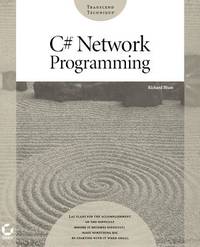

Stock photo: cover may vary
C# Network Programming Paperback - 2002 - 1st Edition
by Blum, Richard
- Used
A$10.31
A$10.21
Delivery to USA
Standard delivery: 5 to 21 days
More delivery options
Standard delivery: 5 to 21 days
Ships from Better World Books Ltd (Fife, United Kingdom)
Details
- Title C# Network Programming
- Author Blum, Richard
- Binding Paperback
- Edition number 1st
- Edition 1
- Condition Used - Good
- Pages 672
- Volumes 1
- Language ENG
- Publisher Wiley & Sons, Incorporated, John, Alameda,CA
- Publication date November 26, 2002
- Illustrated Yes
- Bookseller's Inventory # GRP62415066
- ISBN 9780782141764 / 0782141765
- Weight 2.13 lbs (0.97 kg)
- Dimensions 9.05 x 7.5 x 1.4 in (22.99 x 19.05 x 3.56 cm)
- Category Computers - Languages / Programming
- Library of Congress subjects Internet programming, C (Computer program language)
- Library of Congress Catalogue Number 2002111958
- Dewey Decimal Code 005.133
- Quantity available 2
About Better World Books Ltd Fife, United Kingdom
Biblio member since 2009
Better World Books is a for-profit, socially conscious business and a global online bookseller that collects and sells new and used books online, matching each purchase with a book donation. Each sale generates funds for literacy and education initiatives in the U.S., the U.K., and around the world. Since its launch in 2003, Better World Books has raised over $35 million for libraries and literacy, donated over 38 million books, and reused or recycled more than 475 million books.
Summary
On its own, C# simplifies network programming. Combine it with the precise instruction found in C# Network Programming, and you'll find that building network applications is easier and quicker than ever. This book helps newcomers get started with a look at the basics of network programming as they relate to C#, including the language's network classes, the Winsock interface, and DNS resolution. Spend as much time here as you need, then dig into the core topics of the network layer. You'll learn to make sockets connections via TCP and "connectionless" connections via UDP. You'll also discover just how much help C# gives you with some of your toughest chores, such as asynchronous socket programming, multithreading, and multicasting. Network-layer techniques are just a means to an end, of course, and so this book keeps going, providing a series of detailed application-layer programming examples that show you how to work with real protocols and real network environments to build and implement a variety of applications. Use SNMP to manage network devices, SMTP to communicate with remote mail servers, and HTTP to Web-enable your applications. And use classes native to C# to query and modify Active Directory entries. Rounding it all out is plenty of advanced coverage to push your C# network programming skills to the limit. For example, you'll learn two ways to share application methods across the network: using Web services and remoting. You'll also master the security features intrinsic to C# and .NET--features that stand to benefit all of your programming projects.
Reader reviews for C# Network Programming
Write a review for this book
Important Terms and Guidelines
- Please focus on the book’s content and context. Also, add any personal comments as to how you enjoyed the book. Substantiate your likes and dislikes. You may make comparisons to other books.
- Reviews must be at least 140 characters in length.
- Please do not reveal critical plot elements.
- This is not a help line. Contact customer support if you need help.
Your review must not include:
- Obscenities, discriminatory language, or other insulting language not suitable for public domain
- Advertisements, “spam” content, or references to other products, offers or websites.
- Email addresses, URLs, phone numbers, physical addresses or other contact information.
- Overly critical comments about other reviews or reviewers
- Time-sensitive material (i.e. promotional tours, seminars, lectures, etc.)
- Availability, price, or alternative ordering/shipping information
From the publisher
First line
In its short history, the Microsoft .NET technology has quickly become a popular programming platform for developing applications for Microsoft Windows workstations and servers.

