
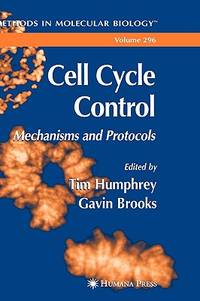
Stock photo: cover may vary
Cell Cycle Control Hardback -
by Tim Humphrey (Editor); Gavin Brooks (Editor)
- Used
- Hardback
A$172.74
A$5.74
Delivery within USA
Standard delivery: 9 to 14 days
More delivery options
Standard delivery: 9 to 14 days
Ships from Cold Books (New York, United States)
Details
- Title Cell Cycle Control
- Author Tim Humphrey (Editor); Gavin Brooks (Editor)
- Binding Hardback
- Edition 1st
- Condition Used
- Pages 404
- Volumes 1
- Language ENG
- Publisher Humana Press
- Publication date pp. 416 Index
- Illustrated Yes
- Features Bibliography, Illustrated, Index
- Bookseller's Inventory # 6286095
- ISBN 9781588291448 / 1588291448
- Weight 1.77 lbs (0.80 kg)
- Dimensions 9.3 x 6.28 x 0.98 in (23.62 x 15.95 x 2.49 cm)
- Category Science
- Library of Congress subjects Molecular Biology - methods, Cell cycle
- Library of Congress Catalogue Number 2004008991
- Dewey Decimal Code 571.84
- Quantity available 1
About Cold Books New York, United States
Reader reviews for Cell Cycle Control
Write a review for this book
Important Terms and Guidelines
- Please focus on the book’s content and context. Also, add any personal comments as to how you enjoyed the book. Substantiate your likes and dislikes. You may make comparisons to other books.
- Reviews must be at least 140 characters in length.
- Please do not reveal critical plot elements.
- This is not a help line. Contact customer support if you need help.
Your review must not include:
- Obscenities, discriminatory language, or other insulting language not suitable for public domain
- Advertisements, “spam” content, or references to other products, offers or websites.
- Email addresses, URLs, phone numbers, physical addresses or other contact information.
- Overly critical comments about other reviews or reviewers
- Time-sensitive material (i.e. promotional tours, seminars, lectures, etc.)
- Availability, price, or alternative ordering/shipping information
From the publisher
First line
The eukaryotic cell cycle can he considered as two distinct events.
From the rear cover
Our understanding of the cell cycle and its regulation has significantly increased with recent discoveries of links to DNA repair, growth, cellular metabolism, development, cell death, proliferative disease, cardiovascular diseases, and cancer. In Cell Cycle Control: Mechanisms and Protocols, internationally recognized researchers not only provide overviews of cell cycle regulatory mechanisms, but also set forth their best techniques for studying the eukaryotic cell cycle and its key regulatory molecules in many major research organisms. Described in step-by-step detail, these readily reproducible methods enable fundamental research on well-defined cell cycle regulators-and those more recently defined-in yeasts, bacteria, plants, Drosophila, Xenopus, and mammals. The protocols follow the successful Methods in Molecular Biology(TM) series format, each offering step-by-step laboratory instructions, an introduction outlining the principle behind the technique, lists of the necessary equipment and reagents, and tips on troubleshooting and avoiding known pitfalls.
Comprehensive and cutting-edge, Cell Cycle Control: Mechanisms and Protocols offers all cell researchers an indispensable collection of critical reviews and techniques essential to investigate how normal cells divide and how this is altered in disease.
Comprehensive and cutting-edge, Cell Cycle Control: Mechanisms and Protocols offers all cell researchers an indispensable collection of critical reviews and techniques essential to investigate how normal cells divide and how this is altered in disease.

