
Stock photo: cover may vary
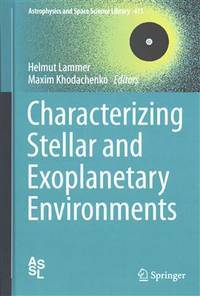
Characterizing Stellar and Exoplanetary Environments... Hardback -
by Helmut Lammer (Editor); Maxim Khodachenko (Editor)
- New
- Hardback
A$254.09
A$5.86
Delivery within USA
Standard delivery: 9 to 14 days
More delivery options
Standard delivery: 9 to 14 days
Ships from Cold Books (New York, United States)
Details
- Title Characterizing Stellar and Exoplanetary Environments...
- Author Helmut Lammer (Editor); Maxim Khodachenko (Editor)
- Binding Hardback
- Condition New
- Pages 310
- Volumes 1
- Language ENG
- Publisher Springer
- Publication date
- Illustrated Yes
- Features Illustrated
- Bookseller's Inventory # 6356782031
- ISBN 9783319097480 / 3319097482
- Weight 1.42 lbs (0.64 kg)
- Dimensions 9.21 x 6.14 x 0.75 in (23.39 x 15.60 x 1.91 cm)
-
Themes
- Aspects (Academic): Science/Technology Aspects
- Category Science
- Dewey Decimal Code 500.5
- Quantity available 4
About Cold Books New York, United States
Reader reviews for Characterizing Stellar and Exoplanetary Environments...
Write a review for this book
Important Terms and Guidelines
- Please focus on the book’s content and context. Also, add any personal comments as to how you enjoyed the book. Substantiate your likes and dislikes. You may make comparisons to other books.
- Reviews must be at least 140 characters in length.
- Please do not reveal critical plot elements.
- This is not a help line. Contact customer support if you need help.
Your review must not include:
- Obscenities, discriminatory language, or other insulting language not suitable for public domain
- Advertisements, “spam” content, or references to other products, offers or websites.
- Email addresses, URLs, phone numbers, physical addresses or other contact information.
- Overly critical comments about other reviews or reviewers
- Time-sensitive material (i.e. promotional tours, seminars, lectures, etc.)
- Availability, price, or alternative ordering/shipping information
From the publisher
From the rear cover
In this book an international group of specialists discusses studies of exoplanets subjected to extreme stellar radiation and plasma conditions. It is shown that such studies will help us to understand how terrestrial planets and their atmospheres, including the early Venus, Earth and Mars, evolved during the host star's active early phase. The book presents an analysis of findings from Hubble Space Telescope observations of transiting exoplanets, as well as applications of advanced numerical models for characterizing the upper atmosphere structure and stellar environments of exoplanets. The authors also address detections of atoms and molecules in the atmosphere of "hot Jupiters" by NASA's Spitzer telescope. The observational and theoretical investigations and discoveries presented are both timely and important in the context of the next generation of space telescopes.
The book is divided into four main parts, grouping chapters on exoplanet host star radiation and plasma environments, exoplanet upper atmosphere and environment observations, exoplanet and stellar magnetospheres, and exoplanet observation and characterization. The book closes with an outlook on the future of this research field.
