
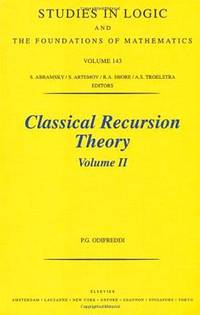
Stock photo: cover may vary
Classical Recursion Theory: The Theory of Functions and Sets of Natural Numbers, Vol. 2 (Studies in Logic and the Foundations of Mathematics, Vol. 143) Hardback - 1999 - 1st Edition
by P. Odifreddi
- New
- Hardback
A$252.67
A$48.23
Delivery to USA
Standard delivery: 7 to 14 days
More delivery options
Standard delivery: 7 to 14 days
Ships from Revaluation Books (Devon, United Kingdom)
Details
- Title Classical Recursion Theory: The Theory of Functions and Sets of Natural Numbers, Vol. 2 (Studies in Logic and the Foundations of Mathematics, Vol. 143)
- Author P. Odifreddi
- Binding Hardback
- Edition number 1st
- Edition 1
- Condition New
- Pages 949
- Volumes 1
- Language ENG
- Publisher North-Holland
- Publication date 1999
- Illustrated Yes
- Features Bibliography, Illustrated, Index, Table of Contents
- Bookseller's Inventory # __044450205X
- ISBN 9780444502056 / 044450205X
- Weight 3.65 lbs (1.66 kg)
- Dimensions 9.1 x 6.4 x 2.5 in (23.11 x 16.26 x 6.35 cm)
- Category Mathematics
- Library of Congress Catalogue Number 88033481
- Dewey Decimal Code 511.3
- Quantity available 1
About Revaluation Books Devon, United Kingdom
Biblio member since 2020
General bookseller of both fiction and non-fiction.
Reader reviews for Classical Recursion Theory: The Theory of Functions and Sets of Natural Numbers, Vol. 2 (Studies in Logic and the Foundations of Mathematics, Vol. 143)
Write a review for this book
Important Terms and Guidelines
- Please focus on the book’s content and context. Also, add any personal comments as to how you enjoyed the book. Substantiate your likes and dislikes. You may make comparisons to other books.
- Reviews must be at least 140 characters in length.
- Please do not reveal critical plot elements.
- This is not a help line. Contact customer support if you need help.
Your review must not include:
- Obscenities, discriminatory language, or other insulting language not suitable for public domain
- Advertisements, “spam” content, or references to other products, offers or websites.
- Email addresses, URLs, phone numbers, physical addresses or other contact information.
- Overly critical comments about other reviews or reviewers
- Time-sensitive material (i.e. promotional tours, seminars, lectures, etc.)
- Availability, price, or alternative ordering/shipping information
From the publisher
First line
As a first approximation, we introduce static complexity measures in an abstract way as follows: given an acceptable system of indices (e)e for the partial recursive functions (see II.5.2), we call a static complexity measure any total recursive function m, and call complexity or size of e the number m(e).

