
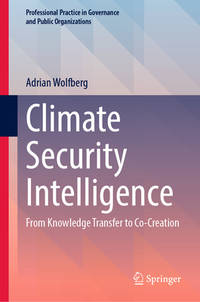
Stock photo: cover may vary
Climate Security Intelligence: From Knowledge Transfer to Co-creation Hardback - 2025
by Wolfberg, Adrian
- New
- Hardback
A$304.45
A$28.98
Delivery to USA
Standard delivery: 7 to 14 days
More delivery options
Standard delivery: 7 to 14 days
Ships from Revaluation Books (Devon, United Kingdom)
Details
- Title Climate Security Intelligence: From Knowledge Transfer to Co-creation
- Author Wolfberg, Adrian
- Binding Hardback
- Condition New
- Pages 436
- Volumes 1
- Language ENG
- Publisher Springer Nature
- Publication date 2025
- Illustrated Yes
- Features Illustrated
- Bookseller's Inventory # x-3031862589
- ISBN 9783031862588 / 3031862589
- Weight 1.8 lbs (0.82 kg)
- Dimensions 9.21 x 6.14 x 1 in (23.39 x 15.60 x 2.54 cm)
- Category Politics / Current Events
- Quantity available 2
About Revaluation Books Devon, United Kingdom
Biblio member since 2020
General bookseller of both fiction and non-fiction.
Reader reviews for Climate Security Intelligence: From Knowledge Transfer to Co-creation
Write a review for this book
Important Terms and Guidelines
- Please focus on the book’s content and context. Also, add any personal comments as to how you enjoyed the book. Substantiate your likes and dislikes. You may make comparisons to other books.
- Reviews must be at least 140 characters in length.
- Please do not reveal critical plot elements.
- This is not a help line. Contact customer support if you need help.
Your review must not include:
- Obscenities, discriminatory language, or other insulting language not suitable for public domain
- Advertisements, “spam” content, or references to other products, offers or websites.
- Email addresses, URLs, phone numbers, physical addresses or other contact information.
- Overly critical comments about other reviews or reviewers
- Time-sensitive material (i.e. promotional tours, seminars, lectures, etc.)
- Availability, price, or alternative ordering/shipping information
From the publisher
From the rear cover
Climate security intelligence is the capacity to warn national and sub-national security organizations of the physical effects of climate change that can have a negative societal effect on nations, governments, and their populations. This book discusses the uniqueness of climate security intelligence, the maturity of its development as a knowledge domain, and its possible future. Written by an intelligence analyst with over forty years of experience, this book centers upon the challenges that organizations may face when analysts, their managers, and their organizations are given the task of warning policymakers and decision-makers about threats to climate security. Taking a necessarily transdisciplinary approach, this book will be of interest to a wide audience of students, researchers, practitioners, and policy-makers concerned with how the impacts of climate change affect the social, cultural, political, and economic stability of national interests.

