
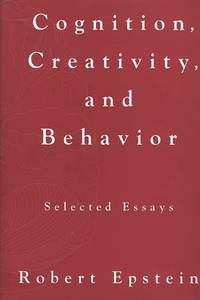
Stock photo: cover may vary
Cognition, Creativity, and Behavior Hardback - 1996
by Robert Epstein
- New
- Hardback
A$794.46
A$21.64
Delivery to USA
Standard delivery: 20 to 30 days
More delivery options
Standard delivery: 20 to 30 days
Ships from Sanctum Books (Delhi, India)
Details
- Title Cognition, Creativity, and Behavior
- Author Robert Epstein
- Binding Hardback
- Edition 1st Edition
- Condition New
- Pages 376
- Volumes 1
- Language ENG
- Publisher Praeger
- Publication date 1996-01-30
- Features Dust Cover
- Bookseller's Inventory # Bloomsbury-9780275944520
- ISBN 9780275944520 / 0275944522
- Weight 1.75 lbs (0.79 kg)
- Dimensions 9.56 x 6.48 x 1.26 in (24.28 x 16.46 x 3.20 cm)
- Reading level 1230
- Category Psychology
- Library of Congress subjects Cognition, Creative ability
- Library of Congress Catalogue Number 95030657
- Dewey Decimal Code 150.194
- Quantity available 500
About Sanctum Books Delhi, India
Specialising in: Art, Archaeology, Art History, And Architecture, Dictionaries And Encyclopaedias, Indian History, Languages, Literature, And Linguistics, Music, Dance, Theatre, And Cinema, Numismatics, Philately, And Epigraphy, Philosophy & Philosophy Of Science, Religion (Buddhism, Jainism, Hinduism, Sikhism, And Islam)
Biblio member since 2010
We are leading publishers, booksellers, distributors, importers, and exporters. We carry a large selection of books on varied subjects. Do place your valued order or let us know your requirement via email.
30 day return guarantee, with full refund including shipping costs for up to 30 days after delivery if an item arrives misdescribed or damaged.
�
Books are shipped by Registered Air Mail or DHL/FedEx/Aramex. Additional shipping charges may be required for multi-volume sets.
Reader reviews for Cognition, Creativity, and Behavior
Write a review for this book
Important Terms and Guidelines
- Please focus on the book’s content and context. Also, add any personal comments as to how you enjoyed the book. Substantiate your likes and dislikes. You may make comparisons to other books.
- Reviews must be at least 140 characters in length.
- Please do not reveal critical plot elements.
- This is not a help line. Contact customer support if you need help.
Your review must not include:
- Obscenities, discriminatory language, or other insulting language not suitable for public domain
- Advertisements, “spam” content, or references to other products, offers or websites.
- Email addresses, URLs, phone numbers, physical addresses or other contact information.
- Overly critical comments about other reviews or reviewers
- Time-sensitive material (i.e. promotional tours, seminars, lectures, etc.)
- Availability, price, or alternative ordering/shipping information
From the publisher
From the rear cover
This diverse set of essays traces Epstein's experimental and theoretical work over a 15-year period. Four of the essays were coauthored by the eminent psychologist B. F. Skinner. The book demonstrates how the scientific study of the behavior can increase our understanding and effectiveness in many domains: creativity and innovation, parenting, artificial intelligence, self-improvement, and even world peace. Reviewers have praised the volume as an impressive effort by one of America's most notable psychologists. The volume paints a fairly consistent picture of Epstein's evolving view on cognition, creativity, and behavior. The first sections focus on generativity research and theory and on some "Columban" (pigeon) simulations of human behavior, including some related laboratory studies. The next sections cover efforts to create a comprehensive science of behavior; esssays about Skinner, one of the principal architects of behaviorism; and forays into artificial intelligence, child rearing, categorization research, and other topics. The volume concludes with some uncertain reflections on growing older and a modest proposal for a day of world peace.

