
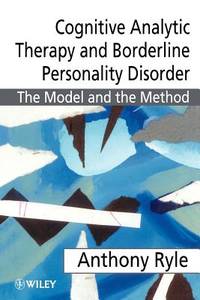
Stock photo: cover may vary
Cognitive Analytic Therapy of Borderline: The Model and the Method Paperback - 1997 - 1st Edition
by Ryle, Anthony
- Used
- Good
- Paperback
A$8.48
A$35.08
Delivery to USA
Standard delivery: 14 to 21 days
More delivery options
Standard delivery: 14 to 21 days
Ships from Worldwide Books Limited (Essex, United Kingdom)
Details
- Title Cognitive Analytic Therapy of Borderline: The Model and the Method
- Author Ryle, Anthony
- Binding Paperback
- Edition number 1st
- Edition 1
- Condition Used - Good
- Pages 208
- Volumes 1
- Language ENG
- Publisher John Wiley & Sons, Chichester, United Kingdom
- Publication date 25/09/1997 00:00:01
- Illustrated Yes
- Features Illustrated
- Bookseller's Inventory # mon0000007960
- ISBN 9780471976189 / 0471976180
- Weight 0.74 lbs (0.34 kg)
- Dimensions 9.18 x 6.28 x 0.49 in (23.32 x 15.95 x 1.24 cm)
- Size 1.5988 in x 22.8826 in x 14.9886
- Category Psychology
- Library of Congress subjects Borderline personality disorder, Cognitive-analytic therapy
- Library of Congress Catalogue Number 97008657
- Dewey Decimal Code 616.858
- Quantity available 1
About Worldwide Books Limited Essex, United Kingdom
Biblio member since 2024
Worldwide Books Ltd has over 30 years of experience selling , new books ,used books and media. We are committed to providing each customer with the highest standard of customer service.
Reader reviews for Cognitive Analytic Therapy of Borderline: The Model and the Method
Write a review for this book
Important Terms and Guidelines
- Please focus on the book’s content and context. Also, add any personal comments as to how you enjoyed the book. Substantiate your likes and dislikes. You may make comparisons to other books.
- Reviews must be at least 140 characters in length.
- Please do not reveal critical plot elements.
- This is not a help line. Contact customer support if you need help.
Your review must not include:
- Obscenities, discriminatory language, or other insulting language not suitable for public domain
- Advertisements, “spam” content, or references to other products, offers or websites.
- Email addresses, URLs, phone numbers, physical addresses or other contact information.
- Overly critical comments about other reviews or reviewers
- Time-sensitive material (i.e. promotional tours, seminars, lectures, etc.)
- Availability, price, or alternative ordering/shipping information
From the publisher
From the rear cover
Borderline Personality Disorder patients are impulsive, unstable and destructive, hurting themselves and those around them, including those who seek to help them. This has resulted in a widespread reluctance to treat them and a pessimism about treatment. In the experience of the authors this pessimism is unjustified, because for many patients a relatively brief intervention can be effective in cost-benefit terms as well as human terms. The interventions illustrated here have been used to treat outpatients for 15 years. The results indicate that treatments can achieve clinically significant changes in the course of 16-24 sessions, in a substantial proportion of patients. While CAT shares some ideas and methods with other approaches, it introduces many new features and is uniquely integrated at both the theoretical and practical level. The early joint reformulation of patients' problems serves to contain destructiveness and to create a working alliance. Also, the use of reformulation to teach self-reflection and avoid collusive responses from the therapist, throughout the therapy, represents a powerful new technique. The book offers a critical appraisal of current ideas and practices, contrasting with these the ways in which CAT mobilizes the patient's own resources. The authors argue that CAT should have a place in any service seeking to help these difficult patients.
From a review of Cognitive Analytic Therapy
Developments in Theory and Practice (Anthony Ryle (Editor), 1995): "Ryle is surely the most original, productive and interesting writer in psychotherapy in Britain today, and CAT is a remarkable systematizing achievement which deserves to be better known on the other side of the Atlantic .... This book documenting CAT's recent theoretical and practical developments is a must for anyone interested in CAT itself and in integrative approaches, for those interested in brief, psychodynamically informed therapy, or indeed for those interested in developments in psychology generally."
--Robert Rentoul, British Journal of Medical Psychology

