BIBLIO is the largest independent book marketplace in the world, with over 100 million books.

Skip to content

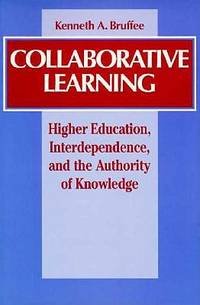
Collaborative Learning : Higher Education, Interdependence, and the Authority of Knowledge

Collaborative Learning : Higher Education, Interdependence, and the Authority of Knowledge

Collaborative Learning : Higher Education, Interdependence, and the Authority of
Stock photo: cover may vary

Collaborative Learning : Higher Education, Interdependence, and the Authority of Knowledge Paperback - 1995

by Bruffee, Kenneth A

Add to wish list
  • Used
Used - Good

Description

Johns Hopkins University Press. Used - Good. Pages intact with minimal writing/highlighting. The binding may be loose and creased. Dust jackets/supplements are not included. Stock photo provided. Product includes identifying sticker. Better World Books: Buy Books. Do Good.
Ask the seller a question Add to wish list
A$14.79
Free Delivery within USA
Standard delivery: 4 to 14 days
More delivery options
Ships from Better World Books (Nevada, United States)

Details

About Better World Books Nevada, United States

Biblio member since 2010

Better World Books is a for-profit, socially conscious business and a global online bookseller that collects and sells new and used books online, matching each purchase with a book donation. Each sale generates funds for literacy and education initiatives in the U.S., the U.K., and around the world. Since its launch in 2003, Better World Books has raised over $35 million for libraries and literacy, donated over 38 million books, and reused or recycled more than 475 million books.

Terms of Sale: Better World Books ("BWB") values your satisfaction and offers you returns within thirty (30) days after the estimated delivery date on most items. All returned items must be in the original condition; used items should include the SKU sticker located on the spine or back of the product. If you have an incomplete, incorrect, or damaged shipment, please contact our Customer Care team via Biblio's contact seller options before proceeding with the return. Please keep in mind that because we deal mostly in used books, any extra components, such as CDs, DVDs, figurines, or access codes are not included.

Browse books from Better World Books

Reader reviews for Collaborative Learning : Higher Education, Interdependence, and the Authority of Knowledge

From the publisher

In Collaborative Learning, Kenneth Bruffee advocates a far-reaching change in the relations we assume between college and university professors and their students, between the learned and the learning. He argues that the nature and source of the authority of college and university professors is the central issue in college and university education in our time, and that if college and university professors continue to teach exclusively in the stand-up-and-tell-'em way, their students will miss the opportunity to learn mature, effective interdependence--and this, Bruffee maintains, is the most important lesson we should expect students to learn. The book makes three related points. First, we should begin thinking about colleges and universities, and they should begin thinking about themselves, not as stores of information but as institutions of reacculturation. Second, we should think of college and university professors not as purveyors of information but as agents of cultural change who foster reacculturation by marshaling interdependence among student pers. And third, colleges and universities should revise longstanding assumptions about the nature and authority of knowledge and about classroom authority. To accomplish this, the author maintains, both college students and their professors must learn collaboratively.

Describing the practical value of the activities encouraged by a collaborative approach--students working in consensus groups and research teams, tutoring peers, and helping each other with editing and revision--Bruffee concludes that, in the short run, collaborative learning helps students learn better--more thoroughly, more deeply, more efficiently--than learningalone. In the long run, collaborative learning is the best possible preparation for the real world, as students look beyond the authority of teachers, practice the craft of interdependence, and construct knowledge in the very way that academic disciplines and the professions do. With no loss of respect for the value of expertise, students learn to depend on one another rather than depending exclusively on the authority of experts and teachers.

In the second edition of this widely respected work, the argument is sharply focused on the need to change college and university education top to bottom, and the need to understand knowledge differently in order to accomplish that change. Several chapters, including that on collaborative learning and computers, have been thoroughly revised, and three new chapters have been added: on differences between collaborative learning and cooperative learning; on literary study and teaching literature; and on postgraduate education.

From Collaborative Learning, second edition:

On the curriculum: Behind every public debate about college curriculum today lie comfortably unchallenged traditional assumptions. When we become fully aware of how deeply and irremediably these traditional assumptions have been challenged by twentieth-century thought, we see that a potentially more serious, and perhaps more rancorous and divisive, educational debate

On the social construction of knowledge: Remember the time Aunty Molly sat on the Thanksgiving turkey? Tell such a story at a family party and family members follow the story easily and get the point, because they are all members of the same small knowledge community. They know the people and the situationthoroughly, and they understand the family's private references.

But try to tell the same story to neighbors or colleagues. For them to follow the story and get the point, you have to explain a lot of obscure details about family events and personalities that they're not familiar with. That is, when a smaller community sets out to integrate itself into a larger one, the level of discourse has to change. The story changes and even its meaning changes as it becomes a constituting narrative of a larger and more complex community.

The main purpose of college or university education is to help older adolescents and adults renegotiate their membership in that encompassing common culture. The foundational knowledge that shapes us as children sooner or later circumscribes our lives. We never entirely outgrow the local, foundational knowledge communities into which we are born. But for most people, the need to cope to one degree or another with the diversity and complexity of human life beyond the local and familiar does outgrow knowledge that is familiar and (locally) foundational.

On postgraduate education: The problem is not that graduate professors do not know what they need to know. The problem is that most of them have learned what they know entirely under the traditional social conditions of academic alienation and aggression. Indeed, the problem is that members of current graduate school faculties were selected into the profession in part because they evidenced those traits. As a result, their fine education and superb reputations as scholars and critics may in some cases actually subvert their ability to understand knowledge as a social construct, learning as an adult socialprocess, and teaching as a role of leadership among adults.

First line

Once upon a time, many years ago, a time when the youngest faculty member at most colleges and universities today had not yet entered puberty, a young assistant professor at one of those colleges was assigned a task that was in those days de rigueur for low level English Department types.
tracking-