BIBLIO is the largest independent book marketplace in the world, with over 100 million books.

Skip to content

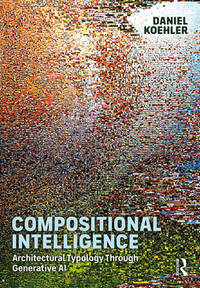
Compositional Intelligence: Architectural Typology Through Generative AI

Compositional Intelligence: Architectural Typology Through Generative AI

Compositional Intelligence: Architectural Typology Through Generative AI
Stock photo: cover may vary

Compositional Intelligence: Architectural Typology Through Generative AI Paperback - 2025

by Koehler, Daniel

Add to wish list
  • Used
  • Paperback
New

Description

Routledge, 9/12/2025 12:00:01 A. paperback. Like New. 0.5906 27.4409 11.7323.
Ask the seller a question Add to wish list
A$47.34
A$7.21 Delivery within USA
Standard delivery: 7 to 14 days
More delivery options
Ships from Schwabe Books (California, United States)

Details

  • Title Compositional Intelligence: Architectural Typology Through Generative AI
  • Author Koehler, Daniel
  • Binding Paperback
  • Condition New
  • Pages 242
  • Volumes 1
  • Language ENG
  • Publisher Routledge
  • Publication date 9/12/2025 12:00:01 A
  • Features Bibliography, Index
  • Bookseller's Inventory # mon0003920289
  • ISBN 9781041030539 / 1041030533
  • Weight 0.99 lbs (0.45 kg)
  • Size 0.5906 27.4409 11.7323
  • Themes
    • Demographic Orientation: Urban
  • Category Architecture
  • Library of Congress subjects Computational linguistics, Architecture and technology
  • Library of Congress Catalogue Number 2025024770
  • Quantity available 4
  • Bookseller catalogues Book

About Schwabe Books California, United States

Biblio member since 2010

We offer over 150,000 books in all subject areas. Heavy concentration in the following subject areas: Academic/university press, Antiquarian/Rare and general non-fiction.

Terms of Sale: 30 day return guarantee, with full refund including original shipping costs for up to 30 days after delivery if an item arrives misdescribed or damaged.

Browse books from Schwabe Books

Reader reviews for Compositional Intelligence: Architectural Typology Through Generative AI

From the publisher

*With a foreword by Mario Carpo*

Given the extensive data sources represented by urban environments, this book investigates the potential of architecting for cities using large-scale models - the technological underpinning of Generative AI. Koehler examines Large Language Models (LLMs) in relation to architectural questions of typology - those critical junctures where architecture engages with the city itself. Typology becomes the interface between an AI model and its modeled audiences, represented languages, and scales of operation.

The investigation reveals how LLMs represent a fundamental shift from comprehending discrete elements to understanding entire languages - introducing a stochastic perspective that transforms how we read and shape urban reality. At the heart of this framework lies the concept of "inductive types" - threshold interfaces that superpose multiple value regimes and actively reconfigure themselves in response to changing urban conditions. By treating architecture as a form of representational materialism rather than a fixed language, designers can engage with complex urban systems while maintaining critical agency.

This approach envisions architecture as an embedding of languages, where buildings become processors of information that compute through their spatial arrangements. The synthetic knowledge produced by LLMs enables access to plural values and stakeholder perspectives, allowing architects to participate in broader material ecologies through computational superposition rather than traditional dialectical methods.

Providing a robust theoretical framework as well as practical insights into how architects can adapt their notational tools and design processes to embrace AI, this will be an essential read for any practicing or researching architect or urban designer interested in the implications of AI on the built environment.

About the author

Daniel Koehler is an urbanist, architect, and Assistant Professor of Architecture Computation at UT Austin. His research, previously conducted at the Bartlett in London and Innsbruck University, led to his first book The Mereological City (Transcript/Columbia Press), examining part-relationships in modernist urbanism. Koehler's work has been exhibited internationally and is included in the Centre Pompidou's permanent collection. He serves on the ACADIA board of directors and the IJAC editorial board. At the intersection of architecture and computation, his research navigates the paradoxes and potentials of AI and digitalization, developing typological interventions that reveal environmental, economic, and societal synergies.

tracking-