
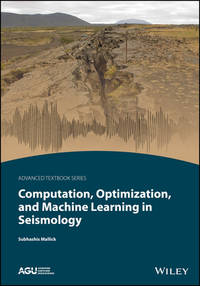
Stock photo: cover may vary
COMPUTATION OPTIMIZATION AND MACHINE LEARNING IN SEISMOLOGY (PB 2026) Paperback -
by MALLICK S
- New
A$320.65
A$5.87
Delivery within USA
Standard delivery: 5 to 10 days
More delivery options
Standard delivery: 5 to 10 days
Details
- Title COMPUTATION OPTIMIZATION AND MACHINE LEARNING IN SEISMOLOGY (PB 2026)
- Author MALLICK S
- Binding Paperback
- Edition USA Edition
- Condition New
- Pages 416
- Volumes 1
- Language ENG
- Publisher American Geophysical Union
- Bookseller's Inventory # CBS 9781119654469
- ISBN 9781119654469 / 1119654467
- Category Science
- Quantity available 1
About XLANCEBOOKS L.L.C. Wyoming, United States
Reader reviews for COMPUTATION OPTIMIZATION AND MACHINE LEARNING IN SEISMOLOGY (PB 2026)
Write a review for this book
Important Terms and Guidelines
- Please focus on the book’s content and context. Also, add any personal comments as to how you enjoyed the book. Substantiate your likes and dislikes. You may make comparisons to other books.
- Reviews must be at least 140 characters in length.
- Please do not reveal critical plot elements.
- This is not a help line. Contact customer support if you need help.
Your review must not include:
- Obscenities, discriminatory language, or other insulting language not suitable for public domain
- Advertisements, “spam” content, or references to other products, offers or websites.
- Email addresses, URLs, phone numbers, physical addresses or other contact information.
- Overly critical comments about other reviews or reviewers
- Time-sensitive material (i.e. promotional tours, seminars, lectures, etc.)
- Availability, price, or alternative ordering/shipping information
From the publisher
From the rear cover
Computation, Optimization, and Machine Learning in Seismology
The goal of computational seismology is to digitally simulate seismic waves, create subsurface models, and match these models with observations to identify subsurface rock properties. With recent advances in computing technology, including machine learning, it is now possible to automate matching procedures and use waveform inversion or optimization to create large-scale models.
Computation, Optimization, and Machine Learning in Seismology provides students with a detailed understanding of seismic wave theory, optimization theory, and how to use machine learning to interpret seismic data.
Volume highlights include:
- Mathematical foundations and key equations for computational seismology
- Essential theories, including wave propagation and elastic wave theory
- Processing, mapping, and interpretation of prestack data
- Model-based optimization and artificial intelligence methods
- Applications for earthquakes, exploration seismology, depth imaging, and multi-objective geophysics problems
- Exercises applying the main concepts of each chapter

