
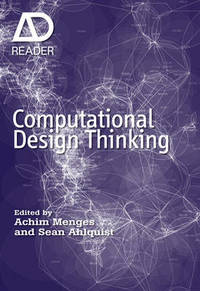
Computational Design Thinking: Computation Design Thinking Paperback / softback - 2011 - 1st Edition
by Achim Menges
- New
- Paperback
A$68.69
A$19.45
Delivery to USA
Standard delivery: 14 to 21 days
More delivery options
Standard delivery: 14 to 21 days
Details
- Title Computational Design Thinking: Computation Design Thinking
- Author Achim Menges
- Binding Paperback
- Edition number 1st
- Edition 1
- Condition New
- Pages 224
- Volumes 1
- Language ENG
- Publisher Wiley, uk:
- Publication date 2011-10-24
- Features Bibliography, Index, Table of Contents
- Bookseller's Inventory # A9780470665657
- ISBN 9780470665657 / 0470665653
- Weight 1.15 lbs (0.52 kg)
- Dimensions 9.4 x 6.5 x 0.6 in (23.88 x 16.51 x 1.52 cm)
- Category Architecture
- Dewey Decimal Code 720.28
- Quantity available 10
About The Saint Bookstore Merseyside, United Kingdom
Biblio member since 2018
The Saint Bookstore specialises in hard to find titles & also offers delivery worldwide for reasonable rates.
Reader reviews for Computational Design Thinking: Computation Design Thinking
Write a review for this book
Important Terms and Guidelines
- Please focus on the book’s content and context. Also, add any personal comments as to how you enjoyed the book. Substantiate your likes and dislikes. You may make comparisons to other books.
- Reviews must be at least 140 characters in length.
- Please do not reveal critical plot elements.
- This is not a help line. Contact customer support if you need help.
Your review must not include:
- Obscenities, discriminatory language, or other insulting language not suitable for public domain
- Advertisements, “spam” content, or references to other products, offers or websites.
- Email addresses, URLs, phone numbers, physical addresses or other contact information.
- Overly critical comments about other reviews or reviewers
- Time-sensitive material (i.e. promotional tours, seminars, lectures, etc.)
- Availability, price, or alternative ordering/shipping information
From the publisher
From the rear cover
Computational Design Thinking, AD Reader
Edited by Achim Menges and Sean Ahlquist
The current transition from Computer Aided Design (CAD) to Computational Design in architecture represents a profound shift in design thinking and methods. Representation is being replaced by simulation, and the crafting of objects is moving towards the generation of integrated systems through designer-authored computational processes. While there is a particular history of such an approach in architecture, its relative newness requires the continued progression of novel modes of design thinking for the architect of the 21st century. This AD Reader establishes a foundation for such thinking. It includes multifaceted reflections and speculations on the profound influence of computational paradigms on architecture. It presents relevant principles from the domains of mathematics and computer science, developmental and evolutionary biology, system science and philosophy, establishing a discourse for computational design thinking in architecture. Rather than a merely technical approach, the book will discuss essential intellectual concepts that are fundamental not only for a discourse on computational design but also for its practice.
This anthology provides a unique collection of seminal texts by authors, who have either provided a significant starting point through which a computational approach to design has been pursued or have played a considerable role in shaping the field. An important aspect of this book is the manner in which adjacent fields and historical texts are connected. Both the source of original inspiration and scientific thought are presented alongside contemporary writings on the continually evolving computational design discourse. Emerging from the field of science, principally the subjects of morphogenesis, evolution and mathematics, selected texts provide a historical basis for a reconfigured mindset of processes that generate, arrange and describe form. Juxtaposed against more contemporary statements regarding the influence of computation on design thinking, the book offers advancements of fundamental texts to the particular purpose of establishing novel thought processes for architecture, theoretically and practically.
- The first reader to provide an effective framework for computational thinking in design.
- Includes classic texts by Johan W. von Goethe, D'Arcy Thompson, Ernst Mayr, Ludwig von Bertalanffy, Gordan Pask, Christopher Alexander, John H. Holland, Nicholas Negroponte, William Mitchell, Peter J. Bentley & David W. Corne, Sanford Kwinter, John Frazer, Kostis Terzidis, Michael Weinstock and Achim Menges
- Features new writing by: Mark Burry, Jane Burry, Manuel DeLanda and Peter Trummer.

