BIBLIO is the largest independent book marketplace in the world, with over 100 million books.

Skip to content

Computational Fluid Dynamics in Aerospace Engineering: Modeling and Analyzing Fluid Flows (Mastering Space Mathematics: Essential Calculations for Rocket Science and Aerospace Engineering)

Computational Fluid Dynamics in Aerospace Engineering: Modeling and Analyzing Fluid Flows (Mastering Space Mathematics: Essential Calculations for Rocket Science and Aerospace Engineering)

Computational Fluid Dynamics in Aerospace Engineering: Modeling and Analyzing
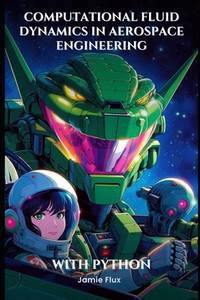
Stock photo: cover may vary

Computational Fluid Dynamics in Aerospace Engineering: Modeling and Analyzing Fluid Flows (Mastering Space Mathematics: Essential Calculations for Rocket Science and Aerospace Engineering) Paperback -

by Jamie Flux

Add to wish list
  • Used
  • Paperback
New

Description

Paperback. Like New/Like New.
Ask the seller a question Add to wish list
A$31.20
A$141.81 Delivery to USA
Standard delivery: 20 to 30 days
More delivery options
Dropship order
Ships from Conti (United Kingdom)

Details

  • Title Computational Fluid Dynamics in Aerospace Engineering: Modeling and Analyzing Fluid Flows (Mastering Space Mathematics: Essential Calculations for Rocket Science and Aerospace Engineering)
  • Author Jamie Flux
  • Binding Paperback
  • Condition New
  • Pages 422
  • Volumes 1
  • Language ENG
  • Publisher Independently Published
  • Bookseller's Inventory # Conti189614
  • ISBN 9798346103769
  • Weight 1.24 lbs (0.56 kg)
  • Dimensions 9 x 6 x 0.86 in (22.86 x 15.24 x 2.18 cm)
  • Category Science
  • Quantity available 1

About Conti United Kingdom

Biblio member since 2026

TUTTI I LIBRI SONO COME DESCRITTO SU BIBLIO

Terms of Sale:

30 day return guarantee, with full refund including original shipping costs for up to 30 days after delivery if an item arrives misdescribed or damaged.

Browse books from Conti

Reader reviews for Computational Fluid Dynamics in Aerospace Engineering: Modeling and Analyzing Fluid Flows (Mastering Space Mathematics: Essential Calculations for Rocket Science and Aerospace Engineering)

From the publisher

Unlock the dynamic world of aerospace engineering and fluid dynamics with a comprehensive guide that marries theoretical rigor with practical application. This indispensable resource is your gateway to mastering Computational Fluid Dynamics (CFD) with Python, empowering you to model and analyze complex fluid flows with precision and efficiency.

Key Features

  • Dive deep into the fundamentals of Python for numerical computing, harnessing libraries like NumPy, SciPy, and Matplotlib for effective CFD applications.
  • Explore advanced Python techniques, including object-oriented programming, to craft efficient and scalable CFD codes.
  • Understand the mathematical bedrock of fluid dynamics through tensor calculus and differential geometry.
  • Master partial differential equations crucial to fluid flow analysis, with focus on derivation and classification.
  • Implement essential CFD equations like the continuity, momentum, and energy equations in practical scenarios.
  • Tackle the nuances of turbulence modeling, grid generation, and high-performance computing to streamline large-scale simulations.

What You Will Learn

  • Utilize Python to perform numerical computing and plotting in fluid dynamics applications.
  • Build efficient CFD codes using object-oriented programming and performance optimization techniques.
  • Grasp the mathematical foundations of fluid mechanics, including tensor calculus.
  • Analyze and solve partial differential equations governing fluid flows.
  • Apply the continuity equation for mass conservation in fluid dynamics.
  • Derive and implement the Navier-Stokes momentum equations.
  • Integrate the energy equation into CFD models, paying attention to compressible flows and thermodynamics.
  • Simplify inviscid flow equations using Euler equations for aerospace applications.
  • Explore potential flow theory for modeling incompressible, irrotational flows.
  • Leverage stream functions and velocity potential formulations for fluid flow analyses.
  • Analyze vorticity and circulation, and model rotational flows numerically.
  • Apply dimensional analysis to derive similarity parameters such as Reynolds and Mach numbers.
  • Learn the non-dimensionalization process of governing fluid dynamics equations.
  • Delve into turbulence modeling, including RANS, LES, and DNS approaches.
  • Model turbulent boundary layers and implement wall modeling strategies.
  • Generate computational grids using structured, unstructured, and adaptive mesh techniques.
  • Assess and optimize mesh quality for better simulation convergence.
  • Implement finite difference, finite volume, and finite element methods for fluid dynamics problems.
  • Develop high-accuracy solutions using spectral and pseudo-spectral methods.
  • Analyze stability, consistency, convergence, and error in numerical schemes.
  • Employ time integration methods like Runge-Kutta to handle unsteady flows.
  • Solve linear and nonlinear equation systems using advanced computational methods.
  • Enhance convergence efficiency with multigrid and preconditioning techniques.
  • Utilize parallel computing, MPI, and OpenMP to manage large-scale CFD simulations.
  • Address fluid-structure interaction scenarios with coupled CFD and structural analyses.
  • Use adjoint methods for aerodynamic optimization and design improvements.
  • Incorporate data assimilation and machine learning to enhance CFD accuracy.
  • Verify and validate CFD models to ensure accuracy and reliability of simulations.

tracking-