
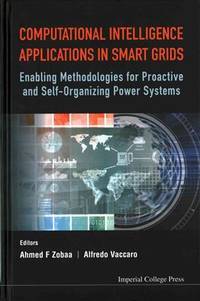
Stock photo: cover may vary
COMPUTATIONAL INTELLIGENCE APPLICATIONS IN SMART GRIDS: ENABLING METHODOLOGIES FOR PROACTIVE AND SELF-ORGANIZING POWER SYSTEMS Hardback - 2015
by Ahmed F Zobaa
- Used
- Good
- Hardback
A$160.91
Free Delivery within USA
Standard delivery: 7 to 14 days
More delivery options
Standard delivery: 7 to 14 days
Dropship order
Ships from Bonita (California, United States)
Details
- Title COMPUTATIONAL INTELLIGENCE APPLICATIONS IN SMART GRIDS: ENABLING METHODOLOGIES FOR PROACTIVE AND SELF-ORGANIZING POWER SYSTEMS
- Author Ahmed F Zobaa
- Binding Hardback
- Condition Used - Good
- Pages 264
- Volumes 1
- Language ENG
- Publisher Imperial College Press
- Publication date 2015-01-03
- Features Bibliography, Index
- Bookseller's Inventory # 1783265876.G
- ISBN 9781783265879 / 1783265876
- Weight 1.23 lbs (0.56 kg)
- Dimensions 9.13 x 6.72 x 0.6 in (23.19 x 17.07 x 1.52 cm)
-
Themes
- Aspects (Academic): Science/Technology Aspects
- Category Computers - Communications / Networking
- Library of Congress subjects Computational intelligence, Smart power grids
- Library of Congress Catalogue Number 2014039079
- Dewey Decimal Code 006.3
- Quantity available 1
About Bonita California, United States
Reader reviews for COMPUTATIONAL INTELLIGENCE APPLICATIONS IN SMART GRIDS: ENABLING METHODOLOGIES FOR PROACTIVE AND SELF-ORGANIZING POWER SYSTEMS
Write a review for this book
Important Terms and Guidelines
- Please focus on the book’s content and context. Also, add any personal comments as to how you enjoyed the book. Substantiate your likes and dislikes. You may make comparisons to other books.
- Reviews must be at least 140 characters in length.
- Please do not reveal critical plot elements.
- This is not a help line. Contact customer support if you need help.
Your review must not include:
- Obscenities, discriminatory language, or other insulting language not suitable for public domain
- Advertisements, “spam” content, or references to other products, offers or websites.
- Email addresses, URLs, phone numbers, physical addresses or other contact information.
- Overly critical comments about other reviews or reviewers
- Time-sensitive material (i.e. promotional tours, seminars, lectures, etc.)
- Availability, price, or alternative ordering/shipping information
From the publisher
From the jacket flap
This book considers the emerging technologies and methodologies of the application of computational intelligence to smart grids.
From a conceptual point of view, the smart grid is the convergence of information and operational technologies applied to the electric grid, allowing sustainable options to customers and improved levels of security. Smart grid technologies include advanced sensing systems, two-way high-speed communications, monitoring and enterprise analysis software, and related services used to obtain location-specific and real-time actionable data for the provision of enhanced services for both system operators (i.e. distribution automation, asset management, advanced metering infrastructure) and end-users (i.e. demand side management, demand response).
In this context, a crucial issue is how to support the evolution of existing electrical grids from static hierarchal systems to self-organizing, highly scalable and pervasive networks. Modern trends are oriented toward the employment of computational intelligence techniques for deploying advanced control, protection and monitoring architectures that move away from the older centralized paradigm to systems distributed across the field with an increasing pervasion of intelligence devices. The large-scale deployment of computational intelligence technologies in smart grids could lead to a more efficient tasks distribution amongst energy resources and, consequently, to a sensible improvement of the electrical grid flexibility.

