
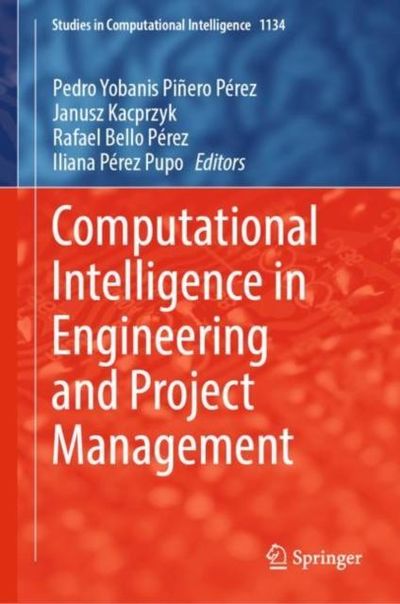
Computational Intelligence in Engineering and Project Management Hardback -
- New
- Hardback
A$306.68
A$15.57
Delivery to USA
Standard delivery: 7 to 12 days
More delivery options
Standard delivery: 7 to 12 days
Ships from Ria Christie Collections (Greater London, United Kingdom)
Details
- Title Computational Intelligence in Engineering and Project Management
- Binding Hardback
- Condition New
- Features Illustrated
- Bookseller's Inventory # ria9783031504945_inp
- ISBN 9783031504945
- Quantity available 994
About Ria Christie Collections Greater London, United Kingdom
Biblio member since 2014
Hello We are professional online booksellers. We sell mostly new books and textbooks and we do our best to provide a competitive price. We are based in Greater London, UK. We pride ourselves by providing a good customer service throughout, shipping the items quickly and replying to customer queries promptly. Ria Christie Collections
30 day return guarantee, with full refund including original shipping costs for up to 30 days after delivery if an item arrives misdescribed or damaged.
Reader reviews for Computational Intelligence in Engineering and Project Management
Write a review for this book
Important Terms and Guidelines
- Please focus on the book’s content and context. Also, add any personal comments as to how you enjoyed the book. Substantiate your likes and dislikes. You may make comparisons to other books.
- Reviews must be at least 140 characters in length.
- Please do not reveal critical plot elements.
- This is not a help line. Contact customer support if you need help.
Your review must not include:
- Obscenities, discriminatory language, or other insulting language not suitable for public domain
- Advertisements, “spam” content, or references to other products, offers or websites.
- Email addresses, URLs, phone numbers, physical addresses or other contact information.
- Overly critical comments about other reviews or reviewers
- Time-sensitive material (i.e. promotional tours, seminars, lectures, etc.)
- Availability, price, or alternative ordering/shipping information
From the publisher
From the rear cover
This book is dedicated to all those interested in the application of artificial intelligence in engineering and project management. Most of the jobs are focused on achieving agile project development. New algorithms that combine various computational intelligence techniques are applied in different areas of knowledge in project management.
In this book, computational intelligence is presented as the branch of AI that encompasses various techniques aimed at simulating human tolerance in decision-making processes in environments with uncertainty and imprecision. Among the precursor techniques of computational intelligence are: evolutionary algorithms, artificial neural networks, fuzzy set theory, and fuzzy systems. However, other areas such as the rough set, linguistic data summary, natural language processing, the conversational systems, fuzzy cognitive maps, collective intelligence, the neutrosophic theory, and other fuzzy logic extensions are contributing to the applicationand extension of computational intelligence
The book is organized into three parts, as shown below. The first part constitutes a critical review of computational intelligence in project management. The second part presents new computational intelligence techniques and their applications in project planning, control, and monitoring processes. In particular, the use of conversational systems and their applicability in the agile management of portfolio programs and projects stand out. Part three of the book exemplifies the use of computing techniques with words and other computational intelligence techniques for organizational decision-making.
The authors of the book stand out for their extensive experience in the development of basic and applied applications of computational intelligence. The authors Janusz Kacprzyk, Pedro Y. Piero Prez, Rafael E. Bello Prez, and Iliana Prez Pupo have published several books associated with artificial intelligence and computational intelligence applied to projects. They continue working on fundamental-oriented and applied research on different artificial intelligence techniques to help with decision-making in different areas of knowledge.
Authors would like to thank all the engineers, professors, and researchers without whose efforts this book could not have been written.

