
Stock photo: cover may vary
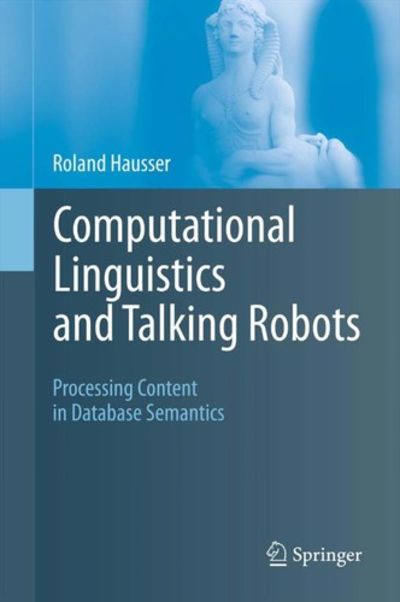
Computational Linguistics and Talking Robots: Processing Content in Database Semantics Hardback - 2011 - 2011th Edition
by Hausser, Roland
- Used
- Good
- Hardback
A$210.45
Free Delivery within USA
Standard delivery: 7 to 14 days
More delivery options
Standard delivery: 7 to 14 days
Dropship order
Ships from Bonita (California, United States)
Details
- Title Computational Linguistics and Talking Robots: Processing Content in Database Semantics
- Author Hausser, Roland
- Binding Hardback
- Edition number 2011th
- Edition 2011
- Condition Used - Good
- Pages 286
- Volumes 1
- Language ENG
- Publisher Springer
- Publication date 2011-08-19
- Features Bibliography
- Bookseller's Inventory # 3642224318.G
- ISBN 9783642224317 / 3642224318
- Weight 1.31 lbs (0.59 kg)
- Dimensions 9.21 x 6.14 x 0.69 in (23.39 x 15.60 x 1.75 cm)
-
Themes
- Aspects (Academic): Science/Technology Aspects
- Category Language Arts / Linguistics / Literacy
- Dewey Decimal Code 005.437
- Quantity available 1
About Bonita California, United States
Reader reviews for Computational Linguistics and Talking Robots: Processing Content in Database Semantics
Write a review for this book
Important Terms and Guidelines
- Please focus on the book’s content and context. Also, add any personal comments as to how you enjoyed the book. Substantiate your likes and dislikes. You may make comparisons to other books.
- Reviews must be at least 140 characters in length.
- Please do not reveal critical plot elements.
- This is not a help line. Contact customer support if you need help.
Your review must not include:
- Obscenities, discriminatory language, or other insulting language not suitable for public domain
- Advertisements, “spam” content, or references to other products, offers or websites.
- Email addresses, URLs, phone numbers, physical addresses or other contact information.
- Overly critical comments about other reviews or reviewers
- Time-sensitive material (i.e. promotional tours, seminars, lectures, etc.)
- Availability, price, or alternative ordering/shipping information
From the rear cover
The practical task of building a talking robot requires a theory of how natural language communication works. Conversely, the best way to computationally verify a theory of natural language communication is to demonstrate its functioning concretely in the form of a talking robot, the epitome of human-machine communication. To build an actual robot requires hardware that provides appropriate recognition and action interfaces, and because such hardware is hard to develop the approach in this book is theoretical: the author presents an artificial cognitive agent with language as a software system called database semantics (DBS). Because a theoretical approach does not have to deal with the technical difficulties of hardware engineering there is no reason to simplify the system - instead the software components of DBS aim at completeness of function and of data coverage in word form recognition, syntactic-semantic interpretation and inferencing, leaving the procedural implementation of elementary concepts for later.
In this book the author first examines the universals of natural language and explains the Database Semantics approach. Then in Part I he examines the following natural language communication issues: using external surfaces; the cycle of natural language communication; memory structure; autonomous control; and learning. In Part II he analyzes the coding of content according to the aspects: semantic relations of structure; simultaneous amalgamation of content; graph-theoretical considerations; computing perspective in dialogue; and computing perspective in text. The book ends with a concluding chapter, a bibliography and an index.
The book will be of value to researchers, graduate students and engineers in the areas of artificial intelligence and robotics, in particular those who deal with natural language processing.

