
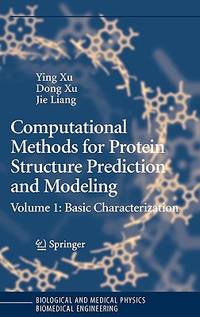
Stock photo: cover may vary
COMPUTATIONAL METHODS FOR PROTEIN STRUCTURE PREDICTION AND MODELING Hardback - 2007 - 2007th Edition
by YING XU, DONG XU , JIE LIANG,
- New
- Hardback
- first
A$132.96
A$28.90
Delivery to USA
Standard delivery: 7 to 12 days
More delivery options
Standard delivery: 7 to 12 days
Details
- Title COMPUTATIONAL METHODS FOR PROTEIN STRUCTURE PREDICTION AND MODELING
- Author YING XU, DONG XU , JIE LIANG,
- Binding Hardback
- Edition number 2007th
- Edition 1st
- Condition New
- Pages 396
- Volumes 1
- Language ENG
- Publisher Springer, New York, N.Y
- Publication date 2007
- Illustrated Yes
- Features Bibliography, Illustrated, Index, Table of Contents
- Bookseller's Inventory # AME_9780387333199
- ISBN 9780387333199 / 0387333193
- Weight 1.55 lbs (0.70 kg)
- Dimensions 9.45 x 6.47 x 0.93 in (24.00 x 16.43 x 2.36 cm)
- Category Science
- Library of Congress subjects Computational biology, Proteins - Structure
- Library of Congress Catalogue Number 2006929615
- Dewey Decimal Code 572.633
- Quantity available 3
About DELHI BOOK STORE Delhi, India
Biblio member since 2007
Our prime concern is to make books available with its extensive choices of titles on all subjects for medicine, engineers, technocrats, corporates, scientists, academics, students, scholars and many more at attractive price range.
Reader reviews for COMPUTATIONAL METHODS FOR PROTEIN STRUCTURE PREDICTION AND MODELING
Write a review for this book
Important Terms and Guidelines
- Please focus on the book’s content and context. Also, add any personal comments as to how you enjoyed the book. Substantiate your likes and dislikes. You may make comparisons to other books.
- Reviews must be at least 140 characters in length.
- Please do not reveal critical plot elements.
- This is not a help line. Contact customer support if you need help.
Your review must not include:
- Obscenities, discriminatory language, or other insulting language not suitable for public domain
- Advertisements, “spam” content, or references to other products, offers or websites.
- Email addresses, URLs, phone numbers, physical addresses or other contact information.
- Overly critical comments about other reviews or reviewers
- Time-sensitive material (i.e. promotional tours, seminars, lectures, etc.)
- Availability, price, or alternative ordering/shipping information
From the publisher
From the rear cover
Volume one of this two volume sequence focuses on the basic characterization of known protein structures as well as structure prediction from protein sequence information. The 11 chapters provide an overview of the field, covering key topics in modeling, force fields, classification, computational methods, and struture prediction. Each chapter is a self contained review designed to cover (1) definition of the problem and an historical perspective, (2) mathematical or computational formulation of the problem, (3) computational methods and algorithms, (4) performance results, (5) existing software packages, and (6) strengths, pitfalls, challenges, and future research directions.

