BIBLIO is the largest independent book marketplace in the world, with over 100 million books.

Skip to content

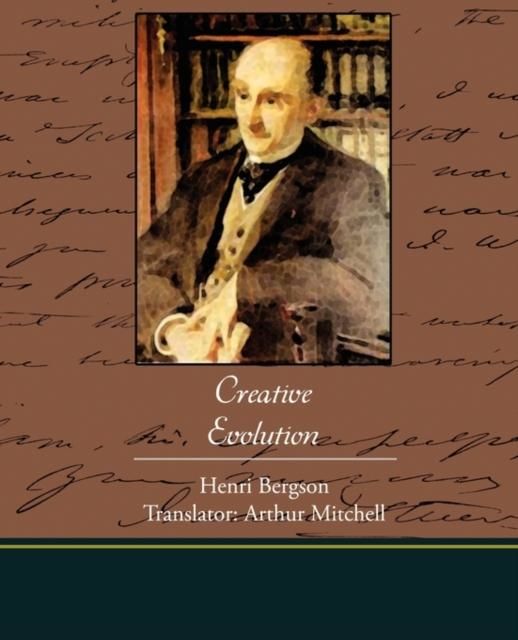
Creative Evolution

Creative Evolution

Creative Evolution Paperback - 2009

by Henri Bergson

Add to wish list
  • New
  • Paperback
New

Description

Paperback. New. New Book; Fast Shipping from UK; Not signed; Not First Edition; N/A
Ask the seller a question Add to wish list
A$53.15
A$15.26 Delivery to USA
Standard delivery: 7 to 12 days
More delivery options
Ships from Ria Christie Collections (Greater London, United Kingdom)

Details

  • Title Creative Evolution
  • Author Henri Bergson
  • Binding Paperback
  • Condition New
  • Pages 286
  • Volumes 1
  • Language ENG
  • Publisher Book Jungle
  • Publication date 2009-11-04
  • Bookseller's Inventory # ria9781438528175_inp
  • ISBN 9781438528175 / 1438528175
  • Weight 1.09 lbs (0.49 kg)
  • Dimensions 9.25 x 7.5 x 0.6 in (23.50 x 19.05 x 1.52 cm)
  • Category Philosophy
  • Dewey Decimal Code 113.8
  • Quantity available 228

About Ria Christie Collections Greater London, United Kingdom

Biblio member since 2014

Hello We are professional online booksellers. We sell mostly new books and textbooks and we do our best to provide a competitive price. We are based in Greater London, UK. We pride ourselves by providing a good customer service throughout, shipping the items quickly and replying to customer queries promptly. Ria Christie Collections

Terms of Sale:

30 day return guarantee, with full refund including original shipping costs for up to 30 days after delivery if an item arrives misdescribed or damaged.

Browse books from Ria Christie Collections

Reader reviews for Creative Evolution

From the publisher

First published in French in 1907, Henri Bergson's L'volution cratrice is a scintillating and radical work by one of the great French philosophers of the nineteenth and twentieth centuries. This outstanding new translation, the first for over a hundred years, brings one of Bergson's most important and ambitious works to a new generation of readers.

A sympathetic though critical reader of Darwin, Bergson argues in Creative Evolution against a mechanistic, reductionist view of evolution. For Bergson, all life emerges from a creative, shared impulse, which he famously terms lan vital and which passes like a current through different organisms and generations over time. Whilst this impulse remains as forms of life diverge and multiply, human life is characterized by a distinctive form of consciousness or intellect. Yet as Bergson brilliantly shows, the intellect's fragmentary and action- oriented nature, which he likens to the cinematograph, means it alone cannot grasp nature's creativity and invention over time. A major task of Creative Evolution is to reconcile these two elements. For Bergson, the answer famously lies in intuition, which brings instinct and intellect together and takes us "into the very interior of life."

A work of great rigour and imaginative richness that contributed to Bergson winning the Nobel Prize for Literature in 1927, Creative Evolution played an important and controversial role in the trajectory of twentieth-century philosophy and continues to create significant discussion and debate. The philosopher and psychologist William James, who admired Bergson's work, was writing an introduction to the first English translation of the book before his death in 1910.

This new translation includes a foreword by Elizabeth Grosz and a helpful translator's introduction by Donald Landes. Also translated for the first time are additional notes, articles, reviews and letters on the reception of Creative Evolution in biology, mathematics, and theology. This edition includes fascinating commentaries by philosophers Maurice Merleau-Ponty, Georges Canguilhem, and Gilles Deleuze.

About the author

Henri Bergson (1859-1941) was born in Paris, the year Darwin's Origin of Species was published. Initially drawn equally by the sciences and philosophy, at the age of eighteen Bergson won a prestigious prize for solving a mathematical problem. Choosing philosophy, he attended the cole Normale Suprieure and the University of Paris before working as a school teacher in Angers and Clermont-Ferrand while completing his doctorate at the University of Paris in 1889. He worked for eight years at the Lyce Henri-IV before taking a position as Chair of Greek and Roman Philosophy at the Collge de France in Paris 1900. His weekly lectures soon attracted beyond capacity crowds, and his visits abroad to England and the United States filled venues and reportedly caused the first-ever traffic jam on Broadway in New York City. Bergson engaged with some of the leading contemporary thinkers, including a famous debate with Einstein in 1922 over the nature of time. He influenced Marcel Proust, Thomas Mann, and the philosopher William James, and was a pioneering figure in the Modernist intellectual movement of the early twentieth century.

tracking-