
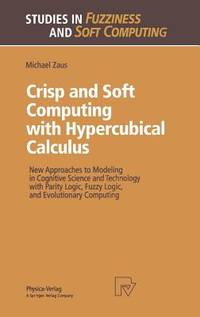
Stock photo: cover may vary
Crisp and Soft Computing with Hypercubical Calculus Hardback - - 1999th Edition
by Michael Zaus
- New
- Hardback
A$373.67
A$5.81
Delivery within USA
Standard delivery: 9 to 14 days
More delivery options
Standard delivery: 9 to 14 days
Ships from Cold Books (New York, United States)
Details
- Title Crisp and Soft Computing with Hypercubical Calculus
- Author Michael Zaus
- Binding Hardback
- Edition number 1999th
- Edition 1999
- Condition New
- Pages 425
- Volumes 1
- Language ENG
- Publisher Physica-Verlag
- Publication date pp. 444
- Illustrated Yes
- Features Illustrated, Maps
- Bookseller's Inventory # 658574139
- ISBN 9783790811728 / 3790811726
- Weight 1.75 lbs (0.79 kg)
- Dimensions 9.21 x 6.14 x 1 in (23.39 x 15.60 x 2.54 cm)
- Category Computers - General Information
- Library of Congress Catalogue Number 98053207
- Dewey Decimal Code 006.3
- Quantity available 4
About Cold Books New York, United States
Reader reviews for Crisp and Soft Computing with Hypercubical Calculus
Write a review for this book
Important Terms and Guidelines
- Please focus on the book’s content and context. Also, add any personal comments as to how you enjoyed the book. Substantiate your likes and dislikes. You may make comparisons to other books.
- Reviews must be at least 140 characters in length.
- Please do not reveal critical plot elements.
- This is not a help line. Contact customer support if you need help.
Your review must not include:
- Obscenities, discriminatory language, or other insulting language not suitable for public domain
- Advertisements, “spam” content, or references to other products, offers or websites.
- Email addresses, URLs, phone numbers, physical addresses or other contact information.
- Overly critical comments about other reviews or reviewers
- Time-sensitive material (i.e. promotional tours, seminars, lectures, etc.)
- Availability, price, or alternative ordering/shipping information
From the publisher
First line
This chapter previews the underlying approaches comprising parity logic, fuzzy logic, and evolutionary computing.
From the rear cover
Three transdisciplinary mainstreams of crisp and soft computing are presented in this book. (1) An entirely new approach to scientific modeling from scratch as based on parity logic with new operators for binary computing and the new framework of Langlet transforms. (2) A compact overview of the foundations of fuzzy logic, and a comprehensive treatment of fuzzy nonlinear dynamical predictor systems in terms of fuzzy cognitive maps. Readers interested in new ways of causal modeling and nonlinear forecasting are introduced to fuzzy knowledge engineering as a paradigm shift in intelligent computing. (3) New perspectives for evolutionary computing with an integro-differential operator from parity logic, and a systematic elaboration of autogenetic algorithms for search in high dimensional feature spaces. Readers interested in fast computing, practical applications of causal reasoning with fuzzy logic, and interactive experimental control environments as based on evolutionary computing, will gain significant insights into a variety of computational power tools.

