
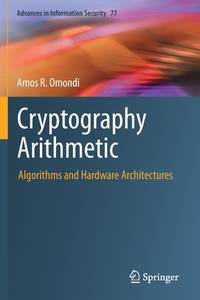
Stock photo: cover may vary
Cryptography Arithmetic: Algorithms and Hardware Architectures (Advances in Information Security) 1st ed. 2020 Edition Papeback -
by Amos R. Omondi
- New
A$161.63
A$5.72
Delivery within USA
Standard delivery: 9 to 14 days
More delivery options
Standard delivery: 9 to 14 days
Ships from Cold Books (New York, United States)
Details
- Title Cryptography Arithmetic: Algorithms and Hardware Architectures (Advances in Information Security) 1st ed. 2020 Edition
- Author Amos R. Omondi
- Binding Papeback
- Condition New
- Pages 336
- Volumes 1
- Language ENG
- Publisher Springer
- Publication date
- Illustrated Yes
- Features Illustrated
- Bookseller's Inventory # 6384588496
- ISBN 9783030341442 / 3030341445
- Weight 1.09 lbs (0.49 kg)
- Dimensions 9.21 x 6.14 x 0.73 in (23.39 x 15.60 x 1.85 cm)
- Category Computers - General Information
- Dewey Decimal Code 004.1
- Quantity available 1
About Cold Books New York, United States
Reader reviews for Cryptography Arithmetic: Algorithms and Hardware Architectures (Advances in Information Security) 1st ed. 2020 Edition
Write a review for this book
Important Terms and Guidelines
- Please focus on the book’s content and context. Also, add any personal comments as to how you enjoyed the book. Substantiate your likes and dislikes. You may make comparisons to other books.
- Reviews must be at least 140 characters in length.
- Please do not reveal critical plot elements.
- This is not a help line. Contact customer support if you need help.
Your review must not include:
- Obscenities, discriminatory language, or other insulting language not suitable for public domain
- Advertisements, “spam” content, or references to other products, offers or websites.
- Email addresses, URLs, phone numbers, physical addresses or other contact information.
- Overly critical comments about other reviews or reviewers
- Time-sensitive material (i.e. promotional tours, seminars, lectures, etc.)
- Availability, price, or alternative ordering/shipping information
From the rear cover
Modern cryptosystems, used in numerous applications that require secrecy or privacy - electronic mail, financial transactions, medical-record keeping, government affairs, social media etc. - are based on sophisticated mathematics and algorithms that in implementation involve much computer arithmetic. And for speed it is necessary that the arithmetic be realized at the hardware (chip) level. This book is an introduction to the implementation of cryptosystems at that level.
The aforementioned arithmetic is mostly the arithmetic of finite fields, and the book is essentially one on the arithmetic of prime fields and binary fields in the context of cryptography. The book has three main parts. The first part is on generic algorithms and hardware architectures for the basic arithmetic operations: addition, subtraction, multiplication, and division. The second part is on the arithmetic of prime fields. And the third part is on the arithmetic of binary fields. The mathematical fundamentals necessary for the latter two parts are included, as are descriptions of various types of cryptosystems, to provide appropriate context.
This book is intended for advanced-level students in Computer Science, Computer Engineering, and Electrical and Electronic Engineering. Practitioners too will find it useful, as will those with a general interest in "hard" applications of mathematics.
The aforementioned arithmetic is mostly the arithmetic of finite fields, and the book is essentially one on the arithmetic of prime fields and binary fields in the context of cryptography. The book has three main parts. The first part is on generic algorithms and hardware architectures for the basic arithmetic operations: addition, subtraction, multiplication, and division. The second part is on the arithmetic of prime fields. And the third part is on the arithmetic of binary fields. The mathematical fundamentals necessary for the latter two parts are included, as are descriptions of various types of cryptosystems, to provide appropriate context.
This book is intended for advanced-level students in Computer Science, Computer Engineering, and Electrical and Electronic Engineering. Practitioners too will find it useful, as will those with a general interest in "hard" applications of mathematics.

