
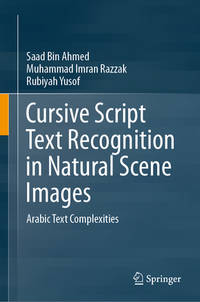
Stock photo: cover may vary
Cursive Script Text Recognition in Natural Scene Images: Arabic Text Complexities Hardback -
by Ahmed, Saad Bin
- Used
- Good
- Hardback
A$228.03
Free Delivery within USA
Standard delivery: 7 to 14 days
More delivery options
Standard delivery: 7 to 14 days
Dropship order
Ships from Bonita (California, United States)
Details
- Title Cursive Script Text Recognition in Natural Scene Images: Arabic Text Complexities
- Author Ahmed, Saad Bin
- Binding Hardback
- Condition Used - Good
- Pages 111
- Volumes 1
- Language ENG
- Publisher Springer
- Bookseller's Inventory # 9811512965.G
- ISBN 9789811512964 / 9811512965
- Weight 1 lbs (0.45 kg)
- Category Computers - General Information
- Dewey Decimal Code 006.312
- Quantity available 1
About Bonita California, United States
Reader reviews for Cursive Script Text Recognition in Natural Scene Images: Arabic Text Complexities
Write a review for this book
Important Terms and Guidelines
- Please focus on the book’s content and context. Also, add any personal comments as to how you enjoyed the book. Substantiate your likes and dislikes. You may make comparisons to other books.
- Reviews must be at least 140 characters in length.
- Please do not reveal critical plot elements.
- This is not a help line. Contact customer support if you need help.
Your review must not include:
- Obscenities, discriminatory language, or other insulting language not suitable for public domain
- Advertisements, “spam” content, or references to other products, offers or websites.
- Email addresses, URLs, phone numbers, physical addresses or other contact information.
- Overly critical comments about other reviews or reviewers
- Time-sensitive material (i.e. promotional tours, seminars, lectures, etc.)
- Availability, price, or alternative ordering/shipping information
From the rear cover
This book offers a broad and structured overview of the state-of-the-art methods that could be applied for context-dependent languages like Arabic. It also provides guidelines on how to deal with Arabic scene data that appeared in an uncontrolled environment impacted by different font size, font styles, image resolution, and opacity of text. Being an intrinsic script, Arabic and Arabic-like languages attract attention from research community. There are a number of challenges associated with the detection and recognition of Arabic text from natural images. This book discusses these challenges and open problems and also provides insights into the complexities and issues that researchers encounter in the context of Arabic or Arabic-like text recognition in natural and document images. It sheds light on fundamental questions, such as a) How the complexity of Arabic as a cursive scripts can be demonstrated b) What the structure of Arabic text is and how to consider the features from a given text and c) What guidelines should be followed to address the context learning ability of classifiers existing in machine learning.

