BIBLIO is the largest independent book marketplace in the world, with over 100 million books.

Skip to content

Data and Reality: A Timeless Perspective on Perceiving and Managing Information in Our Imprecise World, 3rd Edition

Data and Reality: A Timeless Perspective on Perceiving and Managing Information in Our Imprecise World, 3rd Edition

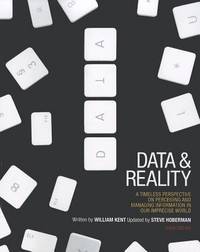
Data and Reality: A Timeless Perspective on Perceiving and Managing Information
Stock photo: cover may vary

Data and Reality: A Timeless Perspective on Perceiving and Managing Information in Our Imprecise World, 3rd Edition Paperback - 2012

by Kent, William

Add to wish list
  • Used
  • Paperback
Used: Good

Description

Technics Publications, 2012-03-19. Third. paperback. Used: Good. 8.00x0.37x10.00. Buy with confidence. Excellent Customer Service & Return policy.
Ask the seller a question Add to wish list
A$49.77
Free Delivery within USA
Standard delivery: 5 to 10 days
More delivery options
Dropship order
Ships from Ergodebooks (Texas, United States)

Details

  • Title Data and Reality: A Timeless Perspective on Perceiving and Managing Information in Our Imprecise World, 3rd Edition
  • Author Kent, William
  • Binding Paperback
  • Edition Third
  • Condition Used: Good
  • Pages 164
  • Volumes 1
  • Language ENG
  • Publisher Technics Publications
  • Publication date 2012-03-19
  • Bookseller's Inventory # SONG1935504215
  • ISBN 9781935504214 / 1935504215
  • Weight 0.99 lbs (0.45 kg)
  • Dimensions 10.01 x 7.98 x 0.49 in (25.43 x 20.27 x 1.24 cm)
  • Size 8.00x0.37x10.00
  • Category Computers - Data Base Management
  • Dewey Decimal Code 005.74
  • Quantity available 1

About Ergodebooks Texas, United States

Biblio member since 2005

Our goal is to provide best customer service and good condition books for the lowest possible price. We are always honest about condition of book. We list book only by ISBN # and hence exact book is guaranteed.

Terms of Sale:

We have 30 day return policy.

Browse books from Ergodebooks

Reader reviews for Data and Reality: A Timeless Perspective on Perceiving and Managing Information in Our Imprecise World, 3rd Edition

From the publisher

Let's step back to the year 1978. Sony introduces hip portable music with the Walkman, Illinois Bell Company releases the first mobile phone, Space Invaders kicks off the video game craze, and William Kent writes Data and Reality. We have made amazing progress in the last four decades in terms of portable music, mobile communication, and entertainment, making devices such as the original Sony Walkman and suitcase-sized mobile phones museum pieces today. Yet remarkably, the book Data and Reality is just as relevant to the field of data management today as it was in 1978.

Data and Reality gracefully weaves the disciplines of psychology and philosophy with data management to create timeless takeaways on how we perceive and manage information. Although databases and related technology have come a long way since 1978, the process of eliciting business requirements and how we think about information remains constant. This book will provide valuable insights whether you are a 1970s data-processing expert or a modern-day business analyst, data modeler, database administrator, or data architect.

This third edition of Data and Reality differs substantially from the first and second editions. Data modeling thought leader Steve Hoberman has updated many of the original examples and references and added his commentary throughout the book, including key points at the end of each chapter.

The important takeaways in this book are rich with insight yet presented in a conversational and easy-to-grasp writing style. Here are just a few of the issues this book tackles:

  • Has "business intelligence" replaced "artificial intelligence"?
  • Why is a map's geographic landscape analogous to a data model's information landscape?
  • Where do forward and reverse engineering fit in our thought process?
  • Why are we all becoming "data archeologists"?
  • What causes the communication chasm between the business professional and the information technology professional in most organizations, and how can the logical data model help bridge this chasm?
  • Why do we invest in hardware and software to solve business problems before determining what the business problems are in the first place?
  • What is the difference between oneness, sameness, and categories?
  • Why does context play a role in every design decision?
  • Why do the more important attributes become entities or relationships?
  • Why do symbols speak louder than words?
  • What's the difference between a data modeler, a philosopher, and an artist?
  • Why is the 1975 dream of mapping all attributes still a dream today?
  • What influence does language have on our perception of reality?
  • Can we distinguish between naming and describing?
tracking-