About Bonita California, United States
Biblio member since 2020
Terms of Sale:
30 day return guarantee, with full refund including original shipping costs for up to 30 days after delivery if an item arrives misdescribed or damaged.
Browse books from Bonita
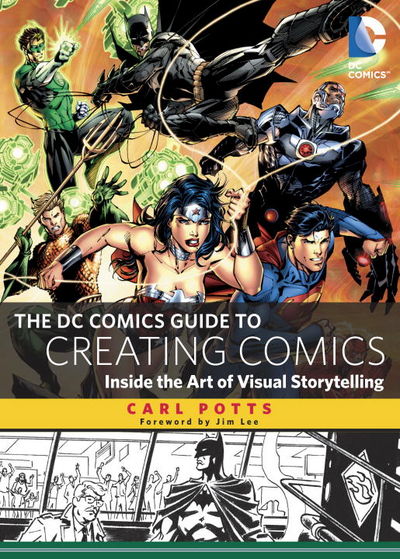
Reader reviews for The DC Comics Guide to Creating Comics: Inside the Art of Visual Storytelling
Write a review for this book
Important Terms and Guidelines
- Please focus on the book’s content and context. Also, add any personal comments as to how you enjoyed the book. Substantiate your likes and dislikes. You may make comparisons to other books.
- Reviews must be at least 140 characters in length.
- Please do not reveal critical plot elements.
- This is not a help line. Contact customer support if you need help.
Your review must not include:
- Obscenities, discriminatory language, or other insulting language not suitable for public domain
- Advertisements, “spam” content, or references to other products, offers or websites.
- Email addresses, URLs, phone numbers, physical addresses or other contact information.
- Overly critical comments about other reviews or reviewers
- Time-sensitive material (i.e. promotional tours, seminars, lectures, etc.)
- Availability, price, or alternative ordering/shipping information
From the publisher
CARL POTTS is a creative director, an editor, an artist, and a writer with years of experience in the comics industry. During his time at Marvel Comics, he discovered and mentored many top comics talents, including Jim Lee, Whilce Portacio, and Mike Mignola. Currently, Potts consults for a variety of publishing, interactive, and entertainment companies, including HarperCollins, Ogilvy & Mather, and the Learning Company. In addition, he’s given seminars on visual storytelling techniques at the School of Visual Arts, Parsons, New York University, LucasArts, Academy of Art University, and the Savannah College of Art and Design.
Excerpt
Nothing gives me greater pleasure than introducing the art of visual storytelling as presented by my mentor and art guru, Carl Potts. For the most part, everything I learned about creating comics can be divided into two periods: the time BC—also known as “Before Carl”—and the time after, which I call “conquering the deep, dark void.” In years 1 to 22 BC, I struggled to learn the art of visual storytelling. Just because you have a love for reading comics and some innate drawing talent, that does not mean you automatically qualify as a comic book artist. In fact, I think it works against you, because you think you know more than you actually do. You think that you draw better than your least favorite professional artist even if you can’t complete an entire page of panel-to-panel continuity by yourself. Ever. That was me.
But somewhere deep inside, I realized I needed to improve. (Because no one was giving me any work, right?) So I learned all I could about comics and visual storytelling through the few books that were available at the local library. However, it wasn’t until I met Carl through another Marvel Comics editor—the late, great Archie Goodwin—that I started on my true path toward enlightenment in the deep, dark void. Because that’s what art can be when you realize you need to start all over again. You have to drop any artifice or defensive shields (the ones you create to preemptively protect yourself from cruel criticism) and accept the fact that there’s a lot more to this artform than meets the eye. You have to learn the basics all over again. For real this time. With feeling. Wax on, wax off.
And that’s where Carl served as my guide. My sensei. My Jedi master. And teach me he did: everything from “the 22 panels that always work” by Wally Wood to “how not to cross the line.” He gave me telephone book–thick tomes of photocopies from books explaining all the ins and outs of cinematic terminology and visual storytelling. Carl passed along handwritten memos explaining what I did well (not much) and what I did wrong (though constructively polite) as I turned in tryout page after tryout page. Carl laid out several of my biggest projects so that I could work over his thumbnails.
I absorbed all those lessons until I thought I was ready to snatch the stone from his hand—the initiation all new artists had to endure and complete to take a place at the vaunted table of professionals. Or maybe it was picking up the burning white-hot urn with your forearms and carrying it to the gates of the dojo. Or maybe he offered me one of two pills in his hands—one blue, one red. I don’t recall that with great accuracy; the endless training has that effect on your mind. But whatever the process, it worked. I emerged a comics professional, trained for the very first time—once again.
I joke about the Zen mysticism of the whole process, but in truth, there is much seriousness to it all. I learned a great deal at the hands of my mentor, Carl. The years working with him set the baseline and foundation for much of my work even as I experimented, grew, and broke the very rules I was initially taught. Because the final lesson for all things creative is written thusly: Just because it works for you, that doesn’t mean it’s the only way of doing something. And I think that was Carl’s ultimate lesson imparted to me and one that is triply clear in this fantastic book you hold in your hands. There are rules and lessons to be learned, but comics are called art for a reason. The subjectivity of it is as clear and true as its objectivity, and that relationship is explored and demonstrated clearly in the chapters ahead.
What took me years to learn can now be yours to enjoy in mere days. May your own journey in the deep, dark void be short and sweet.
Jim Lee
Burbank, California
Media reviews
"...For the artists who are serious about making comics their career, this book belongs in a place of honor among others in their personal libraries."
-Edward Gambichler, www.whatchareading.com
" Instead of “how to” advice, [The DC Comics Guide to Creating Comics] is more about “why”, and I found it a highly educational read, full of good observations about comic construction and structural techniques. There is a ton of really solid information in this book, including the basis of a shared vocabulary (taken in equal parts from Understanding Comics and film phrasing). If more creators followed the advice given here, we wouldn’t have some of the confusing-to-read superhero comics we do. As a critic, the concepts help me better understand when something is well- (or poorly) constructed and why. "
-www.comicsworthreading.com
"If you are an aspiring comic creator, writer, or artist, this is one book you need to read right now. It gets into some of the meat and bones of what makes a good comic. It's more than the story. It's more than the art. It's different than other types of media. And, even if you're only doing one part (i.e. you're not the sole creator of the finished work), you need to understand all the parts and how to bring them together to create a comic. If you're just a fan of comics, this book should still be on your reading list...I highly recommend this as a permanent part of your library for fans and creators alike."
-Sheena McNeil, www.sequentialtart.com