
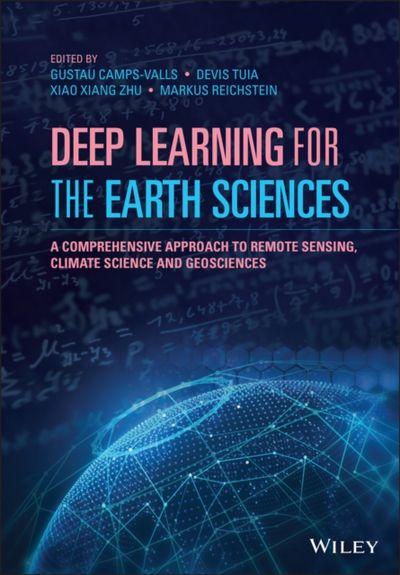
Deep learning for the Earth Sciences Hardback - 2021
by Gustau Camps-Valls
- New
- Hardback
A$224.92
A$15.57
Delivery to USA
Standard delivery: 7 to 12 days
More delivery options
Standard delivery: 7 to 12 days
Ships from Ria Christie Collections (Greater London, United Kingdom)
Details
- Title Deep learning for the Earth Sciences
- Author Gustau Camps-Valls
- Binding Hardback
- Condition New
- Pages 432
- Volumes 1
- Language ENG
- Publisher Wiley
- Publication date 2021-08-16
- Features Bibliography, Index
- Bookseller's Inventory # ria9781119646143_inp
- ISBN 9781119646143 / 1119646146
- Weight 1.95 lbs (0.88 kg)
- Dimensions 9.61 x 6.69 x 0.94 in (24.41 x 16.99 x 2.39 cm)
- Category Technology & Industrial Arts
- Library of Congress subjects Earth sciences - Study and teaching, Algorithms - Study and teaching
- Library of Congress Catalogue Number 2021012965
- Dewey Decimal Code 550.71
- Quantity available 199
About Ria Christie Collections Greater London, United Kingdom
Biblio member since 2014
Hello We are professional online booksellers. We sell mostly new books and textbooks and we do our best to provide a competitive price. We are based in Greater London, UK. We pride ourselves by providing a good customer service throughout, shipping the items quickly and replying to customer queries promptly. Ria Christie Collections
30 day return guarantee, with full refund including original shipping costs for up to 30 days after delivery if an item arrives misdescribed or damaged.
Reader reviews for Deep learning for the Earth Sciences
Write a review for this book
Important Terms and Guidelines
- Please focus on the book’s content and context. Also, add any personal comments as to how you enjoyed the book. Substantiate your likes and dislikes. You may make comparisons to other books.
- Reviews must be at least 140 characters in length.
- Please do not reveal critical plot elements.
- This is not a help line. Contact customer support if you need help.
Your review must not include:
- Obscenities, discriminatory language, or other insulting language not suitable for public domain
- Advertisements, “spam” content, or references to other products, offers or websites.
- Email addresses, URLs, phone numbers, physical addresses or other contact information.
- Overly critical comments about other reviews or reviewers
- Time-sensitive material (i.e. promotional tours, seminars, lectures, etc.)
- Availability, price, or alternative ordering/shipping information
From the publisher
From the rear cover
Explore this insightful treatment of deep learning in the field of earth sciences, from four leading voices
Deep learning is a fundamental technique in modern Artificial Intelligence and is being applied to disciplines across the scientific spectrum; earth science is no exception. Yet, the link between deep learning and Earth sciences has only recently entered academic curricula and thus has not yet proliferated. Deep Learning for the Earth Sciences delivers a unique perspective and treatment of the concepts, skills, and practices necessary to quickly become familiar with the application of deep learning techniques to the Earth sciences. The book prepares readers to be ready to use the technologies and principles described in their own research.
The distinguished editors have also included resources that explain and provide new ideas and recommendations for new research especially useful to those involved in advanced research education or those seeking PhD thesis orientations. Readers will also benefit from the inclusion of:
- An introduction to deep learning for classification purposes, including advances in image segmentation and encoding priors, anomaly detection and target detection, and domain adaptation
- An exploration of learning representations and unsupervised deep learning, including deep learning image fusion, image retrieval, and matching and co-registration
- Practical discussions of regression, fitting, parameter retrieval, forecasting and interpolation
- An examination of physics-aware deep learning models, including emulation of complex codes and model parametrizations
Perfect for PhD students and researchers in the fields of geosciences, image processing, remote sensing, electrical engineering and computer science, and machine learning, Deep Learning for the Earth Sciences will also earn a place in the libraries of machine learning and pattern recognition researchers, engineers, and scientists.

