
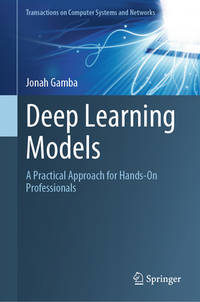
Stock photo: cover may vary
Deep Learning Models: A Practical Approach for Hands-On Professionals (Transactions on Computer Systems and Networks) Hardback - 2024
by Jonah Gamba
- New
- Hardback
A$313.07
A$5.77
Delivery within USA
Standard delivery: 9 to 14 days
More delivery options
Standard delivery: 9 to 14 days
Ships from Cold Books (New York, United States)
Details
- Title Deep Learning Models: A Practical Approach for Hands-On Professionals (Transactions on Computer Systems and Networks)
- Author Jonah Gamba
- Binding Hardback
- Condition New
- Pages 201
- Volumes 1
- Language ENG
- Publisher Springer
- Publication date 2024th edition NO-PA16APR20
- Illustrated Yes
- Features Illustrated
- Bookseller's Inventory # 6399396214
- ISBN 9789819996711 / 9819996716
- Weight 1.06 lbs (0.48 kg)
- Dimensions 9.21 x 6.14 x 0.56 in (23.39 x 15.60 x 1.42 cm)
- Category Computers - General Information
- Quantity available 1
About Cold Books New York, United States
Reader reviews for Deep Learning Models: A Practical Approach for Hands-On Professionals (Transactions on Computer Systems and Networks)
Write a review for this book
Important Terms and Guidelines
- Please focus on the book’s content and context. Also, add any personal comments as to how you enjoyed the book. Substantiate your likes and dislikes. You may make comparisons to other books.
- Reviews must be at least 140 characters in length.
- Please do not reveal critical plot elements.
- This is not a help line. Contact customer support if you need help.
Your review must not include:
- Obscenities, discriminatory language, or other insulting language not suitable for public domain
- Advertisements, “spam” content, or references to other products, offers or websites.
- Email addresses, URLs, phone numbers, physical addresses or other contact information.
- Overly critical comments about other reviews or reviewers
- Time-sensitive material (i.e. promotional tours, seminars, lectures, etc.)
- Availability, price, or alternative ordering/shipping information
From the publisher
From the rear cover
This book focuses on and prioritizes a practical approach, minimizing theoretical concepts to deliver algorithms effectively. With deep learning emerging as a vibrant field of research and development in numerous industrial applications, there is a pressing need for accessible resources that provide comprehensive examples and quick guidance. Unfortunately, many existing books on the market tend to emphasize theoretical aspects, leaving newcomers scrambling for practical guidance. This book takes a different approach by focusing on practicality while keeping theoretical concepts to a necessary minimum. The book begins by laying a foundation of basic information on deep learning, gradually delving into the subject matter to explain and illustrate the limitations of existing algorithms. A dedicated chapter is allocated to evaluating the performance of multiple algorithms on specific datasets, highlighting techniques and strategies that can address real-world challenges when deep learning is employed. By consolidating all necessary information into a single resource, readers can bypass the hassle of scouring scattered online sources, gaining a one-stop solution to dive into deep learning for object detection and classification. To facilitate understanding, the book employs a rich array of illustrations, figures, tables, and code snippets. Comprehensive code examples are provided, empowering readers to grasp concepts quickly and develop practical solutions. The book covers essential methods and tools, ensuring a complete and comprehensive coverage that enables professionals to implement deep learning algorithms swiftly and effectively.
This book is designed to equip professionals with the necessary skills to thrive in the active field of deep learning, where it has the potential to revolutionize traditional problem-solving approaches. This book serves as a practical companion, enabling readers to grasp concepts swiftly and embark on building practical solutions.
This book is designed to equip professionals with the necessary skills to thrive in the active field of deep learning, where it has the potential to revolutionize traditional problem-solving approaches. This book serves as a practical companion, enabling readers to grasp concepts swiftly and embark on building practical solutions.

