
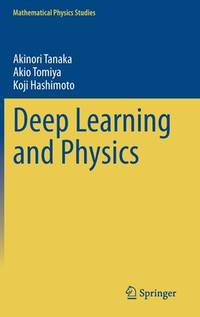
Stock photo: cover may vary
Deep Learning and Physics Hardback - 2021
by Akinori Tanaka; Akio Tomiya; Koji Hashimoto
Add to wish list
Reader reviews for Deep Learning and Physics
Write a review for this book
Important Terms and Guidelines
- Please focus on the book’s content and context. Also, add any personal comments as to how you enjoyed the book. Substantiate your likes and dislikes. You may make comparisons to other books.
- Reviews must be at least 140 characters in length.
- Please do not reveal critical plot elements.
- This is not a help line. Contact customer support if you need help.
Your review must not include:
- Obscenities, discriminatory language, or other insulting language not suitable for public domain
- Advertisements, “spam” content, or references to other products, offers or websites.
- Email addresses, URLs, phone numbers, physical addresses or other contact information.
- Overly critical comments about other reviews or reviewers
- Time-sensitive material (i.e. promotional tours, seminars, lectures, etc.)
- Availability, price, or alternative ordering/shipping information
From the publisher
From the rear cover
What is deep learning for those who study physics? Is it completely different from physics? Or is it similar?
In recent years, machine learning, including deep learning, has begun to be used in various physics studies. Why is that? Is knowing physics useful in machine learning? Conversely, is knowing machine learning useful in physics?
This book is devoted to answers of these questions. Starting with basic ideas of physics, neural networks are derived naturally. And you can learn the concepts of deep learning through the words of physics.
In fact, the foundation of machine learning can be attributed to physical concepts. Hamiltonians that determine physical systems characterize various machine learning structures. Statistical physics given by Hamiltonians defines machine learning by neural networks. Furthermore, solving inverse problems in physics through machine learning and generalization essentially provides progress and even revolutions in physics. For these reasons, in recent years interdisciplinary research in machine learning and physics has been expanding dramatically.
This book is written for anyone who wants to learn, understand, and apply the relationship between deep learning/machine learning and physics. All that is needed to read this book are the basic concepts in physics: energy and Hamiltonians. The concepts of statistical mechanics and the bracket notation of quantum mechanics, which are explained in columns, are used to explain deep learning frameworks.
We encourage you to explore this new active field of machine learning and physics, with this book as a map of the continent to be explored.
In recent years, machine learning, including deep learning, has begun to be used in various physics studies. Why is that? Is knowing physics useful in machine learning? Conversely, is knowing machine learning useful in physics?
This book is devoted to answers of these questions. Starting with basic ideas of physics, neural networks are derived naturally. And you can learn the concepts of deep learning through the words of physics.
In fact, the foundation of machine learning can be attributed to physical concepts. Hamiltonians that determine physical systems characterize various machine learning structures. Statistical physics given by Hamiltonians defines machine learning by neural networks. Furthermore, solving inverse problems in physics through machine learning and generalization essentially provides progress and even revolutions in physics. For these reasons, in recent years interdisciplinary research in machine learning and physics has been expanding dramatically.
This book is written for anyone who wants to learn, understand, and apply the relationship between deep learning/machine learning and physics. All that is needed to read this book are the basic concepts in physics: energy and Hamiltonians. The concepts of statistical mechanics and the bracket notation of quantum mechanics, which are explained in columns, are used to explain deep learning frameworks.
We encourage you to explore this new active field of machine learning and physics, with this book as a map of the continent to be explored.
Details
- Title Deep Learning and Physics
- Author Akinori Tanaka; Akio Tomiya; Koji Hashimoto
- Binding Hardback
- Pages 207
- Volumes 1
- Language ENG
- Publisher Springer
- Publication date 2021-02-21
- Illustrated Yes
- Features Bibliography, Illustrated
- ISBN 9789813361072 / 9813361077
- Weight 1.08 lbs (0.49 kg)
- Dimensions 9.21 x 6.14 x 0.56 in (23.39 x 15.60 x 1.42 cm)
- Category Science
About the author
More Copies for Sale
Deep Learning and Physics
by Akinori Tanaka
- New
- Hardback
- Condition
- New
- Binding
- Hardcover
- ISBN 10 / ISBN 13
- 9789813361072 / 9813361077
- Quantity available
- 130
- Seller
- Item price
-
A$216.24A$15.18 Delivery to USA
Show details
Add to wish list
Item price
A$216.24
A$15.18
Delivery to USA
Stock photo: cover may vary
Deep Learning and Physics (Mathematical Physics Studies)
by Tanaka, Akinori
- Used
- Good
- Hardback
- Condition
- Good
- Binding
- Hardcover
- ISBN 10 / ISBN 13
- 9789813361072 / 9813361077
- Quantity available
- 1
- Seller
- Item price
-
A$205.09Free Delivery to USA
Show details
Add to wish list
Item price
A$205.09
Free Delivery to USA
Stock photo: cover may vary
Deep Learning and Physics
by Tanaka, Akinori/ Tomiya, Akio/ Hashimoto, Koji
- New
- Hardback
- Condition
- New
- Binding
- Hardcover
- ISBN 10 / ISBN 13
- 9789813361072 / 9813361077
- Quantity available
- 2
- Seller
- Item price
-
A$286.27A$47.50 Delivery to USA
Show details
Add to wish list
Item price
A$286.27
A$47.50
Delivery to USA
Stock photo: cover may vary
Deep Learning and Physics (Mathematical Physics Studies)
- New
- Hardback
- Condition
- New
- Binding
- Hardcover
- ISBN 10 / ISBN 13
- 9789813361072 / 9813361077
- Quantity available
- 4
- Seller
- Item price
-
A$283.92A$5.63 Delivery to USA
Show details
Add to wish list
Item price
A$283.92
A$5.63
Delivery to USA
