
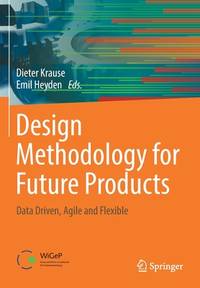
Stock photo: cover may vary
Design Methodology for Future Products: Data Driven, Agile and Flexible Other -
by Dieter Krause (Editor); Emil Heyden (Editor)
- New
A$265.46
A$5.74
Delivery within USA
Standard delivery: 9 to 14 days
More delivery options
Standard delivery: 9 to 14 days
Ships from Cold Books (New York, United States)
Details
- Title Design Methodology for Future Products: Data Driven, Agile and Flexible
- Author Dieter Krause (Editor); Emil Heyden (Editor)
- Binding Other
- Condition New
- Pages 306
- Volumes 1
- Language ENG
- Publisher Springer
- Publication date
- Illustrated Yes
- Features Illustrated
- Bookseller's Inventory # 6395350386
- ISBN 9783030783709 / 3030783707
- Weight 1.12 lbs (0.51 kg)
- Dimensions 9.61 x 6.69 x 0.67 in (24.41 x 16.99 x 1.70 cm)
- Category Technology & Industrial Arts
- Quantity available 4
About Cold Books New York, United States
Reader reviews for Design Methodology for Future Products: Data Driven, Agile and Flexible
Write a review for this book
Important Terms and Guidelines
- Please focus on the book’s content and context. Also, add any personal comments as to how you enjoyed the book. Substantiate your likes and dislikes. You may make comparisons to other books.
- Reviews must be at least 140 characters in length.
- Please do not reveal critical plot elements.
- This is not a help line. Contact customer support if you need help.
Your review must not include:
- Obscenities, discriminatory language, or other insulting language not suitable for public domain
- Advertisements, “spam” content, or references to other products, offers or websites.
- Email addresses, URLs, phone numbers, physical addresses or other contact information.
- Overly critical comments about other reviews or reviewers
- Time-sensitive material (i.e. promotional tours, seminars, lectures, etc.)
- Availability, price, or alternative ordering/shipping information
From the publisher
From the rear cover
Design Methodology for Future Products - Data Driven, Agile and Flexible provides an overview of the recent research in the field of design methodology from the point of view of the members of the scientific society for product development (WiGeP - Wissenschaftliche Gesellschaft fr Produktenwicklung e.V.). This book aims to contribute to design methods and their implementation for innovative future products. The main focus is the crucial data-driven, agile, and flexible way of working.
Four topics are covered in corresponding chapters, Methods for Product Development and Management, Methods for Specific Products and Systems, Facing the Challenges in Product Development and Model-Based Engineering in Product Development.
This publication starts with the agile strategic foresight of sustainable mechatronic and cyber-physical systems, moves on to the topics ofsystem generation engineering in development processes, followed by the technical inheritance in data-driven product development. Product improvements are shown via agile experiential learning based on reverse engineering and via combination of usability and emotions. Furthermore, the development of future-oriented products in the field of biomechatronic systems, sustainable mobility systems and in situ sensor integration is shown. The overcoming of challenges in product development is demonstrated through context-adapted methods by focusing on efficiency and effectiveness, as well as designer-centered methods to tackle cognitive bias. Flow design for target-oriented availability of data and information in product development is addressed. Topics of model-based systems engineering are applied to the function-driven product development by linking model elements at all stages and phases of the product. The potential of model-based systems engineering for modular product families and engineering of multidisciplinary complex systems is shown.

