
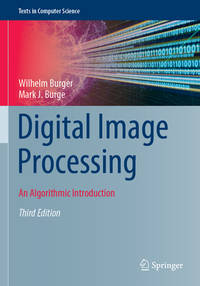
Stock photo: cover may vary
Digital Image Processing An Algorithmic Introduction 3Ed (Pb 2022) Paperback - 2023
by Burger W
- New
A$198.75
A$33.42
Delivery to USA
Standard delivery: 5 to 9 days
More delivery options
Standard delivery: 5 to 9 days
Ships from FBS (California, United States)
Details
- Title Digital Image Processing An Algorithmic Introduction 3Ed (Pb 2022)
- Author Burger W
- Binding Paperback
- Condition New
- Pages 945
- Volumes 1
- Language ENG
- Publisher Springer
- Publication date 2023-07-24
- Illustrated Yes
- Features Illustrated
- Bookseller's Inventory # C--5289
- ISBN 9783031063435 / 3031063430
- Weight 3.63 lbs (1.65 kg)
- Dimensions 10 x 7 x 1.91 in (25.40 x 17.78 x 4.85 cm)
- Category Computers - Other Applications
- Quantity available 1
About FBS California, United States
Biblio member since 2023
I have a book store in location California. we are keep used and new books.
Reader reviews for Digital Image Processing An Algorithmic Introduction 3Ed (Pb 2022)
Write a review for this book
Important Terms and Guidelines
- Please focus on the book’s content and context. Also, add any personal comments as to how you enjoyed the book. Substantiate your likes and dislikes. You may make comparisons to other books.
- Reviews must be at least 140 characters in length.
- Please do not reveal critical plot elements.
- This is not a help line. Contact customer support if you need help.
Your review must not include:
- Obscenities, discriminatory language, or other insulting language not suitable for public domain
- Advertisements, “spam” content, or references to other products, offers or websites.
- Email addresses, URLs, phone numbers, physical addresses or other contact information.
- Overly critical comments about other reviews or reviewers
- Time-sensitive material (i.e. promotional tours, seminars, lectures, etc.)
- Availability, price, or alternative ordering/shipping information
From the publisher
From the rear cover
This modern, self-contained textbook provides an accessible introduction to the field from the perspective of a practicing programmer, supporting a detailed presentation of the fundamental concepts and techniques with practical exercises and fully worked out implementation examples. This much-anticipated 3rd edition of the definitive textbook on digital image processing has been completely revised and expanded with new content, improved illustrations and teaching material.
Topics and features:
Advanced undergraduate and graduate students will find this comprehensive and example-rich textbook will serve as the ideal introduction to digital image processing. It will also prove invaluable to researchers and professionals seeking a practically focused self-study primer.
Dr. Wilhelm Burger is an emeritus of the University of Applied Sciences Upper Austria atHagenberg, where he served as Head of the Digital Media degree programs at the School ofInformatics, Communications and Media.
Dr. Mark J. Burge is the Senior Advisor for Artificial Intelligence at the Federal Bureau ofInvestigation, Washington, DC, USA. His other publications include the Handbook of IrisRecognition.
Topics and features:
- Contains new chapters on fitting of geometric primitives, randomized feature detection (RANSAC), and maximally stable extremal regions (MSER)
- Includes exercises for most chapters and provides additional supplementary materials and software implementations at an associated website
- Uses ImageJ for all examples, a widely used open source imaging environment that can run on all major platforms
- Describes each solution in a stepwise manner in mathematical form, as abstract pseudocode algorithms, and as complete Java programs that can be easily ported to other programming languages
- Presents suggested outlines for a one- or two-semester course in the preface
Advanced undergraduate and graduate students will find this comprehensive and example-rich textbook will serve as the ideal introduction to digital image processing. It will also prove invaluable to researchers and professionals seeking a practically focused self-study primer.
Dr. Wilhelm Burger is an emeritus of the University of Applied Sciences Upper Austria atHagenberg, where he served as Head of the Digital Media degree programs at the School ofInformatics, Communications and Media.
Dr. Mark J. Burge is the Senior Advisor for Artificial Intelligence at the Federal Bureau ofInvestigation, Washington, DC, USA. His other publications include the Handbook of IrisRecognition.

