
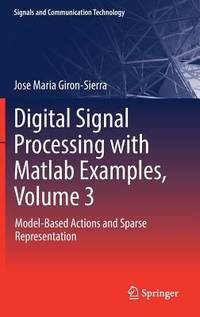
Stock photo: cover may vary
DIGITAL SIGNAL PROCESSING WITH MATLAB EXAMPLES, VOLUME 3 Other - 2016
by Jose Maria Giron-Sierra
- New
A$287.73
A$5.78
Delivery within USA
Standard delivery: 9 to 14 days
More delivery options
Standard delivery: 9 to 14 days
Ships from Cold Books (New York, United States)
Details
- Title DIGITAL SIGNAL PROCESSING WITH MATLAB EXAMPLES, VOLUME 3
- Author Jose Maria Giron-Sierra
- Binding Other
- Condition New
- Pages 431
- Volumes 1
- Language ENG
- Publisher Springer
- Publication date 2016-12-01
- Illustrated Yes
- Features Illustrated
- Bookseller's Inventory # 6375635150
- ISBN 9789811025396 / 9811025398
- Weight 1.76 lbs (0.80 kg)
- Dimensions 9.21 x 6.14 x 1 in (23.39 x 15.60 x 2.54 cm)
- Category Technology & Industrial Arts
- Dewey Decimal Code 621.382
- Quantity available 4
About Cold Books New York, United States
Reader reviews for DIGITAL SIGNAL PROCESSING WITH MATLAB EXAMPLES, VOLUME 3
Write a review for this book
Important Terms and Guidelines
- Please focus on the book’s content and context. Also, add any personal comments as to how you enjoyed the book. Substantiate your likes and dislikes. You may make comparisons to other books.
- Reviews must be at least 140 characters in length.
- Please do not reveal critical plot elements.
- This is not a help line. Contact customer support if you need help.
Your review must not include:
- Obscenities, discriminatory language, or other insulting language not suitable for public domain
- Advertisements, “spam” content, or references to other products, offers or websites.
- Email addresses, URLs, phone numbers, physical addresses or other contact information.
- Overly critical comments about other reviews or reviewers
- Time-sensitive material (i.e. promotional tours, seminars, lectures, etc.)
- Availability, price, or alternative ordering/shipping information
From the publisher
From the rear cover
This is the third volume in a trilogy on modern Signal Processing. The three books provide a concise exposition of signal processing topics, and a guide to support individual practical exploration based on MATLAB programs.
This book includes MATLAB codes to illustrate each of the main steps of the theory, offering a self-contained guide suitable for independent study. The code is embedded in the text, helping readers to put into practice the ideas and methods discussed.
The book primarily focuses on filter banks, wavelets, and images. While the Fourier transform is adequate for periodic signals, wavelets are more suitable for other cases, such as short-duration signals: bursts, spikes, tweets, lung sounds, etc. Both Fourier and wavelet transforms decompose signals into components. Further, both are also invertible, so the original signals can be recovered from their components. Compressed sensing has emerged as a promising idea. One of the intended applications is networked devices or sensors, which are now becoming a reality; accordingly, this topic is also addressed. A selection of experiments that demonstrate image denoising applications are also included. In the interest of reader-friendliness, the longer programs have been grouped in an appendix; further, a second appendix on optimization has been added to supplement the content of the last chapter.

