
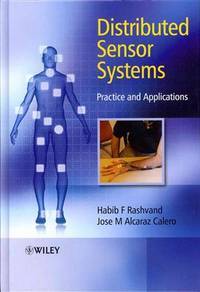
Stock photo: cover may vary
Distributed Sensor Systems: Practice and Applications Hardback - 2012 - 1st Edition
by Habib F. Rashvand
- Used
- Hardback
- first
A$23.05
Free Delivery within USA
Standard delivery: 5 to 10 days
More delivery options
Standard delivery: 5 to 10 days
Dropship order
Ships from Ergodebooks (Texas, United States)
Details
- Title Distributed Sensor Systems: Practice and Applications
- Author Habib F. Rashvand
- Binding Hardback
- Edition number 1st
- Edition 1
- Condition Used: Good
- Pages 384
- Volumes 1
- Language ENG
- Publisher Wiley
- Publication date 2012-04-23
- Illustrated Yes
- Features Bibliography, Illustrated, Index
- Bookseller's Inventory # SONG0470661240
- ISBN 9780470661246 / 0470661240
- Weight 1.55 lbs (0.70 kg)
- Dimensions 9.8 x 6.7 x 0.9 in (24.89 x 17.02 x 2.29 cm)
- Size 6.80x0.85x9.90
-
Themes
- Aspects (Academic): Science/Technology Aspects
- Category Technology & Industrial Arts
- Library of Congress subjects Sensor networks - Design and construction, Sensor networks - Industrial applications
- Library of Congress Catalogue Number 2011051663
- Dewey Decimal Code 681.2
- Quantity available 1
About Ergodebooks Texas, United States
Biblio member since 2005
Our goal is to provide best customer service and good condition books for the lowest possible price. We are always honest about condition of book. We list book only by ISBN # and hence exact book is guaranteed.
We have 30 day return policy.
Reader reviews for Distributed Sensor Systems: Practice and Applications
Write a review for this book
Important Terms and Guidelines
- Please focus on the book’s content and context. Also, add any personal comments as to how you enjoyed the book. Substantiate your likes and dislikes. You may make comparisons to other books.
- Reviews must be at least 140 characters in length.
- Please do not reveal critical plot elements.
- This is not a help line. Contact customer support if you need help.
Your review must not include:
- Obscenities, discriminatory language, or other insulting language not suitable for public domain
- Advertisements, “spam” content, or references to other products, offers or websites.
- Email addresses, URLs, phone numbers, physical addresses or other contact information.
- Overly critical comments about other reviews or reviewers
- Time-sensitive material (i.e. promotional tours, seminars, lectures, etc.)
- Availability, price, or alternative ordering/shipping information
From the publisher
From the rear cover
This book focuses on the distinct but tightly inter-related areas of development for distributed sensing systems
In this book, the authors discuss the technological developments lead by sensor technology, addressing viable new applications to inspire a technological evolution. Under the advanced and visionary approach of distributed intelligence, the authors focus on three distinct but tightly inter-related areas of developments for distributed sensing systems (DSS): firstly, the sensor technology embracing the conversion of the phenomena of interest into desirable form of signal such as electric, secondly, the interaction process between sensing points which requires immense intelligence loosely called networking, and finally, the adoption of useful maturing systems through potential applications for right impacts for a better life and a brighter economy. Furthermore, the book contains a number of case studies and typical applications illustrating the technical details, features and functions of the systems, as well as demonstrating their benefits and limitations.
Key Features:
- Discusses the technological developments lead by sensor technology
- Addresses viable new applications
- Contains a number of case studies and typical applications illustrating the technical details, features and functions of the systems
- Demonstrates the benefits and limitations of distributed sensing
- Written by experts with vast experience in the field (both in academia and industry)
This book will be an invaluable reference for postgraduates studying related courses (communication engineering, engineering management, computer systems, industrial process, automation, design, environmental, urban, surveillance), R&D engineers, system and application designers, researchers, industrial project managers and engineers, and technical and strategic managers planning new products

