
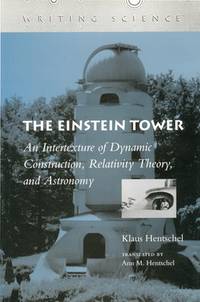
Stock photo: cover may vary
The Einstein Tower: An Intertexture of Dynamic Construction, Relativity Theory, and Astronomy (Writing Science) Hard cover - 1997
by Hentschel, Klaus; Hentschel, Ann M. (translator)
- Used
- as new
- Hardback
A$36.05
A$6.14
Delivery within USA
Standard delivery: 2 to 9 days
More delivery options
Standard delivery: 2 to 9 days
Details
- Title The Einstein Tower: An Intertexture of Dynamic Construction, Relativity Theory, and Astronomy (Writing Science)
- Author Hentschel, Klaus; Hentschel, Ann M. (translator)
- Binding Hardback
- Edition First Edition
- Condition New
- Pages 244
- Volumes 1
- Language ENG
- Publisher Stanford University Press, Stanford, CA, U.S.A.
- Publication date 1997
- Illustrated Yes
- Features Illustrated
- Bookseller's Inventory # 005370
- ISBN 9780804728249 / 0804728240
- Weight 1.15 lbs (0.52 kg)
- Dimensions 9.31 x 6.22 x 0.8 in (23.65 x 15.80 x 2.03 cm)
- Category Science
- Library of Congress subjects Physicists - Biography, Astronomers - Germany - Biography
- Library of Congress Catalogue Number 96048509
- Dewey Decimal Code 530.110
About House of Our Own Books Pennsylvania, United States
Biblio member since 2005

Our shop is located on two floors of a quiet, comfortable Victorian house on the edge of the University of Pennsylvania campus. The large stock of general and scholarly books is divided between new and used, and is well-organized and categorized. ** Only a very small fraction of our inventory is currently on the internet, so if you do not find what you are looking for, please contact us by phone or email to see if we have a copy in the store. ** CAUTION: If you use the large search box on this page you are searching OUR online inventory. If you use any other search box you may be searching the entire online inventory of ALL Biblio booksellers.
Hours: Mon &Tue, Thu & Fri, 11:00 to 6:00 / Sat & Sun, 12:00-6:00 / Closed Wed
Most book orders are shipped the same day or the next day, except on weekends.
Reader reviews for The Einstein Tower: An Intertexture of Dynamic Construction, Relativity Theory, and Astronomy (Writing Science)
Write a review for this book
Important Terms and Guidelines
- Please focus on the book’s content and context. Also, add any personal comments as to how you enjoyed the book. Substantiate your likes and dislikes. You may make comparisons to other books.
- Reviews must be at least 140 characters in length.
- Please do not reveal critical plot elements.
- This is not a help line. Contact customer support if you need help.
Your review must not include:
- Obscenities, discriminatory language, or other insulting language not suitable for public domain
- Advertisements, “spam” content, or references to other products, offers or websites.
- Email addresses, URLs, phone numbers, physical addresses or other contact information.
- Overly critical comments about other reviews or reviewers
- Time-sensitive material (i.e. promotional tours, seminars, lectures, etc.)
- Availability, price, or alternative ordering/shipping information
From the publisher
From the rear cover
This book focuses on the "Einstein Tower," an architecturally historic observatory built in Potsdam in 1920 to allow the German astronomer Erwin Finlay Freundlich to attempt to verify experimentally Einstein's general theory of relativity. Freundlich, who was the first German astronomer to show a genuine interest in Einstein's theory, managed to interest his architect friend Erich Mendelsohn in designing this unique building. Freundlich's researches were not a success; he came to doubt the very theory he was attempting to prove. (Adequate technology to test Einstein's theory lay many decades in the future.) By contrast, as an experiment in modernist architecture, the building led to international fame for Mendelsohn.
To develop a full historical picture of this moment in the history of science, the book interweaves several descriptive levels: the biography of Freundlich; the social context in which he interacted with teachers, co-workers, students, his patrons (including Einstein), and scientific opponents; the cognitive aspects of his attempts to verify Einstein's theory; the political milieu within the Berlin scientific research community; and a cross-national comparison of astrophysics.
Other layers of the narrative include the place of the Einstein Tower in architectural history; economics and sociopsychological components of the Tower's financing and construction; the reception of the Tower and the theory; a historical examination of the Tower's research results; and the effect on Freundlich and on the work at the Tower of the National Socialists' rise to power.
To develop a full historical picture of this moment in the history of science, the book interweaves several descriptive levels: the biography of Freundlich; the social context in which he interacted with teachers, co-workers, students, his patrons (including Einstein), and scientific opponents; the cognitive aspects of his attempts to verify Einstein's theory; the political milieu within the Berlin scientific research community; and a cross-national comparison of astrophysics.
Other layers of the narrative include the place of the Einstein Tower in architectural history; economics and sociopsychological components of the Tower's financing and construction; the reception of the Tower and the theory; a historical examination of the Tower's research results; and the effect on Freundlich and on the work at the Tower of the National Socialists' rise to power.

