
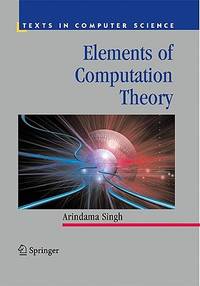
Stock photo: cover may vary
Elements of Computation Theory (Texts in Computer Science) Hardback - 2009
by Singh, Arindama
- Used
- Good
- Hardback
A$129.29
Free Delivery within USA
Standard delivery: 7 to 14 days
More delivery options
Standard delivery: 7 to 14 days
Dropship order
Ships from Bonita (California, United States)
Details
- Title Elements of Computation Theory (Texts in Computer Science)
- Author Singh, Arindama
- Binding Hardback
- Edition 1st edition
- Condition Used - Good
- Pages 422
- Volumes 1
- Language ENG
- Publisher Springer, USA
- Publication date 2009
- Illustrated Yes
- Bookseller's Inventory # 1848824963.G
- ISBN 9781848824966 / 1848824963
- Weight 2.08 lbs (0.94 kg)
- Dimensions 9.25 x 7.01 x 1.1 in (23.50 x 17.81 x 2.79 cm)
- Category Computers - General Information
- Library of Congress subjects Computer science, Machine theory
- Library of Congress Catalogue Number 2009455622
- Dewey Decimal Code 004
- Quantity available 1
About Bonita California, United States
Reader reviews for Elements of Computation Theory (Texts in Computer Science)
Write a review for this book
Important Terms and Guidelines
- Please focus on the book’s content and context. Also, add any personal comments as to how you enjoyed the book. Substantiate your likes and dislikes. You may make comparisons to other books.
- Reviews must be at least 140 characters in length.
- Please do not reveal critical plot elements.
- This is not a help line. Contact customer support if you need help.
Your review must not include:
- Obscenities, discriminatory language, or other insulting language not suitable for public domain
- Advertisements, “spam” content, or references to other products, offers or websites.
- Email addresses, URLs, phone numbers, physical addresses or other contact information.
- Overly critical comments about other reviews or reviewers
- Time-sensitive material (i.e. promotional tours, seminars, lectures, etc.)
- Availability, price, or alternative ordering/shipping information
From the publisher
From the rear cover
As Computer Science progressively matures as an established discipline, it becomes increasingly important to revisit its theoretical foundations, learn the appropriate techniques for answering theory-based questions, and build one's confidence in implementing this knowledge when building computer applications. Students well-grounded in theory and abstract models of computation can excel in computing's many application arenas.
Through a deft interplay of rigor and intuitive motivation, Elements of Computation Theory comprehensively, yet flexibly provides students with the grounding they need in computation theory. The book is self-contained and introduces the fundamental concepts, models, techniques, and results that form the basic paradigms of computing. Readers will benefit from the discussion of the ideas and mathematics that computer scientists use to model, to debate, and to predict the behavior of algorithms and computation. Previous learning about set theory and proof by induction are helpful prerequisites.
Topics and features:
- Contains an extensive use of definitions, proofs, exercises, problems, and other pedagogical aids
- Supplies a summary, bibliographical remarks, and additional (progressively challenging) problems in each chapter, as well as an appendix containing hints and answers to selected problems
- Reviews mathematical preliminaries such as set theory, relations, graphs, trees, functions, cardinality, Cantor's diagonalization, induction, and the pigeon-hole principle
- Explores regular languages, covering the mechanisms for representing languages, the closure properties of such languages, the existence of other languages, and other structural properties
- Investigates the class of context-free languages, including context-free grammars, Pushdown automata, their equivalence, closure properties, and existence of non-context-free languages
- Discusses thetrue nature of general algorithms, introducing unrestricted grammars, Turing machines, and their equivalence
- Examines which tasks can be achieved by algorithms and which tasks can't, covering issues of decision problems in regular languages, context-free languages, and computably enumerable languages
- Provides a concise account of both space and time complexity, explaining the main techniques of log space reduction, polynomial time reduction, and simulations
- Promotes students' confidence via interactive learning and motivational, yet informal dialogue
- Emphasizes intuitive aspects and their realization with rigorous formalization
Undergraduate students of computer science, engineering, and mathematics will find this core textbook ideally suited for courses on the theory of computation, automata theory, formal languages, and computational models. Computing professionals and other scientists will also benefit from the work's accessibility, plethora of learning aids, and motivated exposition.
Dr. Arindama Singh is a professor at the Department of Mathematics of the Indian Institute of Technology Madras and has authored books on logic for computer science.

