
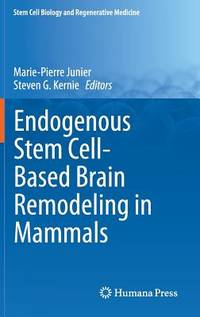
Stock photo: cover may vary
Endogenous Stem Cell-Based Brain Remodeling in Mammals Hardback -
by Marie-Pierre Junier (Editor); Steven G. Kernie (Editor)
- New
- Hardback
A$263.42
A$5.78
Delivery within USA
Standard delivery: 9 to 14 days
More delivery options
Standard delivery: 9 to 14 days
Ships from Cold Books (New York, United States)
Details
- Title Endogenous Stem Cell-Based Brain Remodeling in Mammals
- Author Marie-Pierre Junier (Editor); Steven G. Kernie (Editor)
- Binding Hardback
- Condition New
- Pages 230
- Volumes 1
- Language ENG
- Publisher Springer
- Publication date pp. viii + 230
- Illustrated Yes
- Features Bibliography, Illustrated, Index
- Bookseller's Inventory # 697845810
- ISBN 9781489973986 / 1489973982
- Weight 1.35 lbs (0.61 kg)
- Dimensions 9.2 x 6.3 x 0.7 in (23.37 x 16.00 x 1.78 cm)
- Category Science
- Library of Congress subjects Stem cells - Research, Stem Cells - physiology
- Library of Congress Catalogue Number 2014931105
- Dewey Decimal Code 571.6
- Quantity available 4
About Cold Books New York, United States
Reader reviews for Endogenous Stem Cell-Based Brain Remodeling in Mammals
Write a review for this book
Important Terms and Guidelines
- Please focus on the book’s content and context. Also, add any personal comments as to how you enjoyed the book. Substantiate your likes and dislikes. You may make comparisons to other books.
- Reviews must be at least 140 characters in length.
- Please do not reveal critical plot elements.
- This is not a help line. Contact customer support if you need help.
Your review must not include:
- Obscenities, discriminatory language, or other insulting language not suitable for public domain
- Advertisements, “spam” content, or references to other products, offers or websites.
- Email addresses, URLs, phone numbers, physical addresses or other contact information.
- Overly critical comments about other reviews or reviewers
- Time-sensitive material (i.e. promotional tours, seminars, lectures, etc.)
- Availability, price, or alternative ordering/shipping information
From the publisher
From the rear cover
This book uses the juvenile mammalian brain as a starting point to describe how different injury mechanisms influence neuronal and glial progenitor response to injury, and how in certain circumstances, these cells might play adaptive or harmful roles in recovery. It also provides an overview of emerging concepts in progenitor biology and how current understanding of the processes regulating these cells has tempered some of the initial enthusiasm regarding their therapeutic potential. Only recently has significant effort been devoted to the study of late neurogenesis in mammals, though this interesting phenomenon was first described over fifty years ago. In many settings, injury accelerates the ongoing neurogenesis now known to occur, and recently described reservoirs of glial progenitors add to the pool of existing reparative possibilities.
Dr. Steven G. Kernie is an Associate Professor of Pediatrics and Pathology & Cell Biology at Columbia University in New York and Chief of Critical Care Medicine at Morgan Stanley Children's Hospital at Columbia University Medical Center. His laboratory is interested in how the brain repairs itself following injury. The presence of adult neural stem and progenitor cells in the mammalian brain has awakened new interest and optimism in potential treatment for a variety of acquired brain disorders. The Kernie lab is investigating how adult neural stem and progenitor cells participate in injury-induced remodeling and in identifying genes and drugs that might be important in augmenting their contribution. In order to do this, they have generated a variety of transgenic mice that allow for temporally controlled alterations in the endogenous stem cell population in order to optimize the post-injury remodeling that occurs.
Dr. Marie-Pierre Junier is Research Director at Inserm and co-PI of team Glial Plasticity for the Center of Research Neuroscience Paris Seine at the University Pierre etMarie Curie. Her team showed the permissiveness of astrocytes to re-programming into immature states akin to neural progenitors or neural stem cells. It further demonstrated that these plastic capabilities of astrocytes sensitize them to cancerous transformation. The team is now using cancer stem cells isolated from human adult and pediatric gliomas to understand their differences from normal human neural stem cells. Combining proteomic, metabolic and epigenetic approaches, the team aims at developing new therapeutic strategies against these devastating cancers.

